Silicon is the New Oil

This is the part most relevant to MU:

Intel will retain its Optane business and invest proceeds from the transaction to grow that business. The Optane division develops next-generation, nonvolatile memory chips with data speeds faster than Nand.

Intel and Micron developed this tech together but are now competitors with their own product lines. It seems intel just offloaded the low end stuff to the Koreans but retains the high end stuff.

Bad news for MU? I trade EWT, no idea what the article is talking about. Specifically no idea about the implications :woozy_face:

Maybe a wash to slightly positive? More consolidation in vanilla NAND business is good for existing players. High end competition from Intel has always been there maybe it will get a bit hotter? But then Intel’s execution has been awful for the last 10 years so I won’t read too much into it.

1 Like

Doesn’t show up in prices.

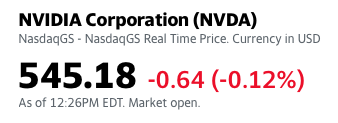
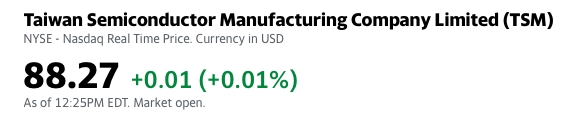
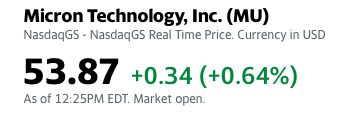
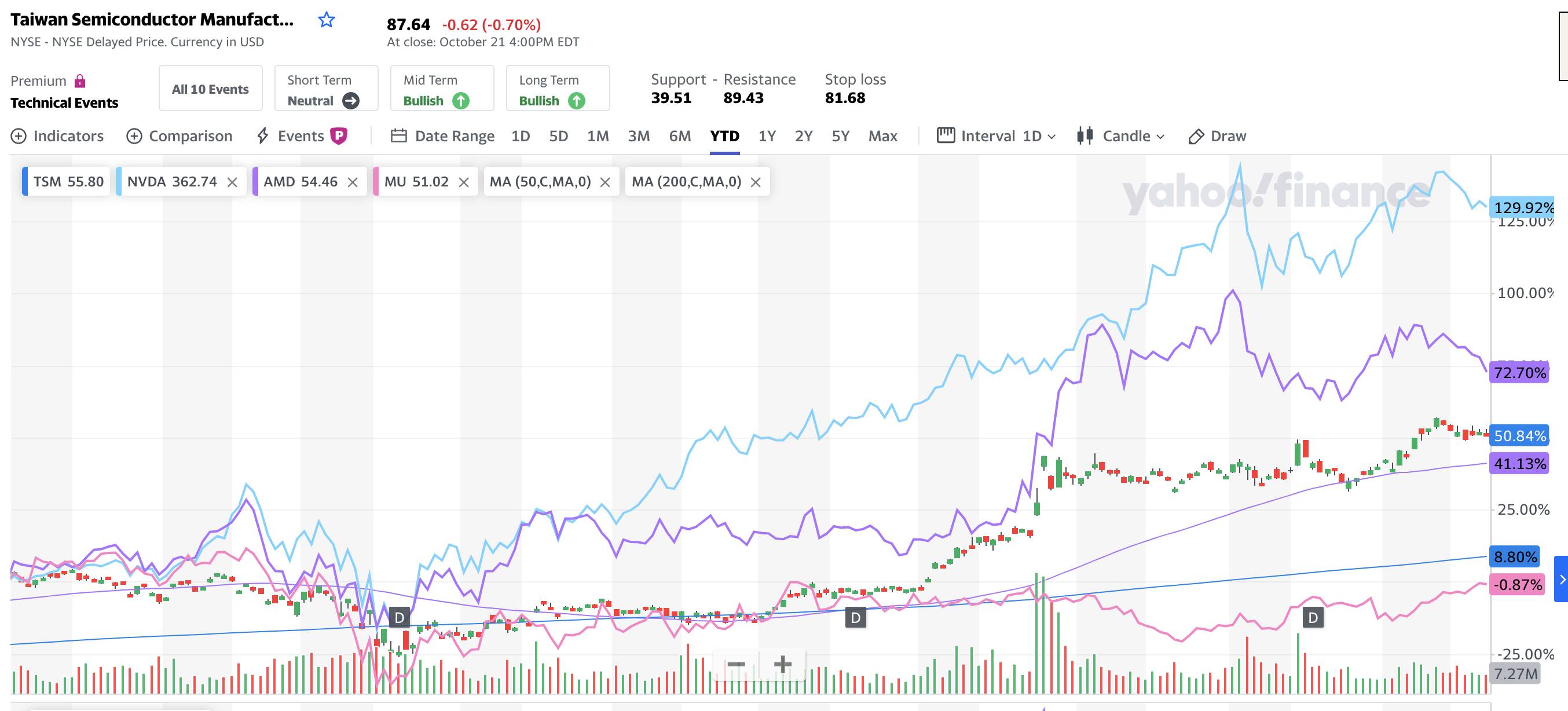
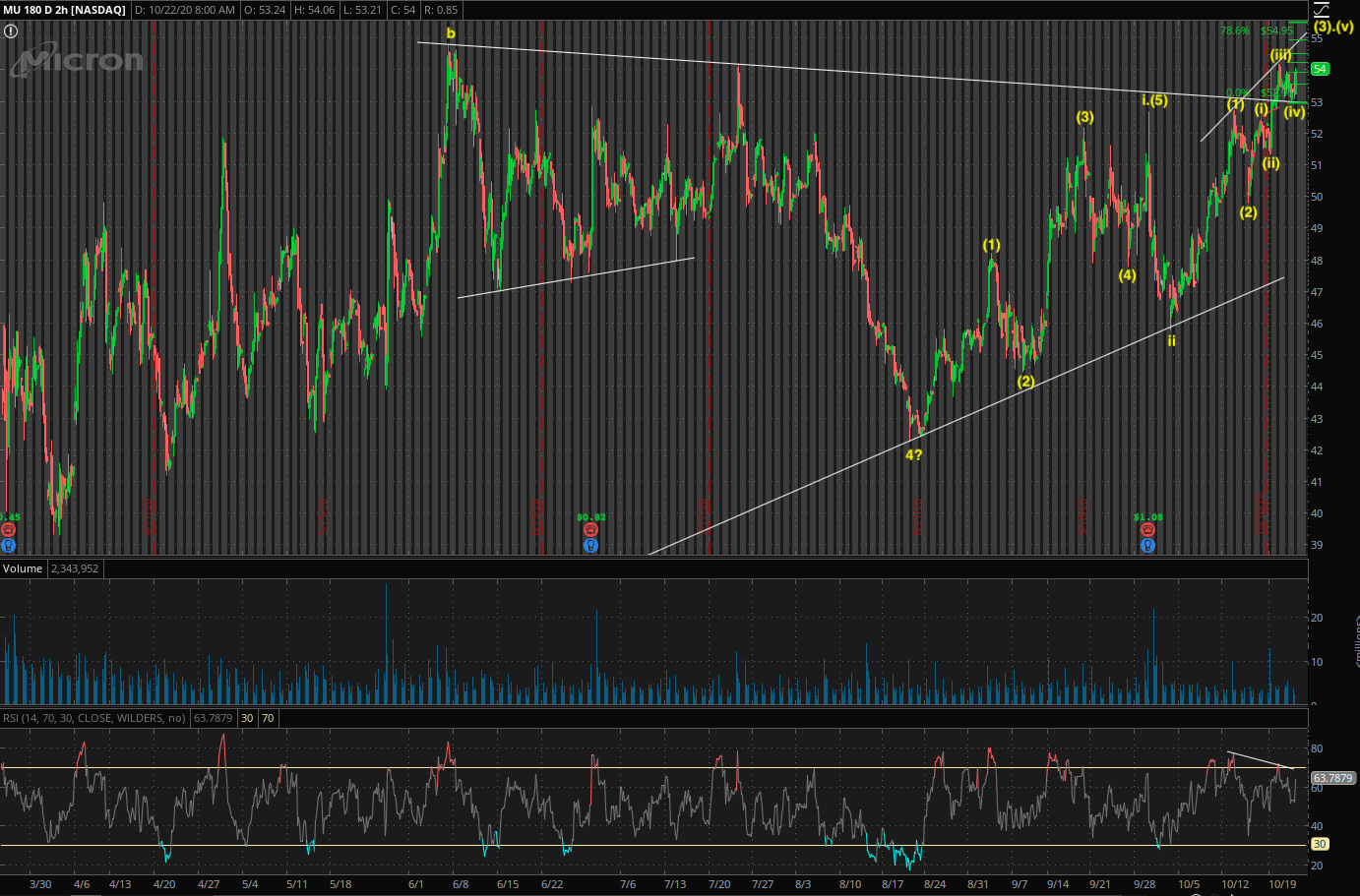
Screen Shot 2020-10-21 at 11.26.11 AM
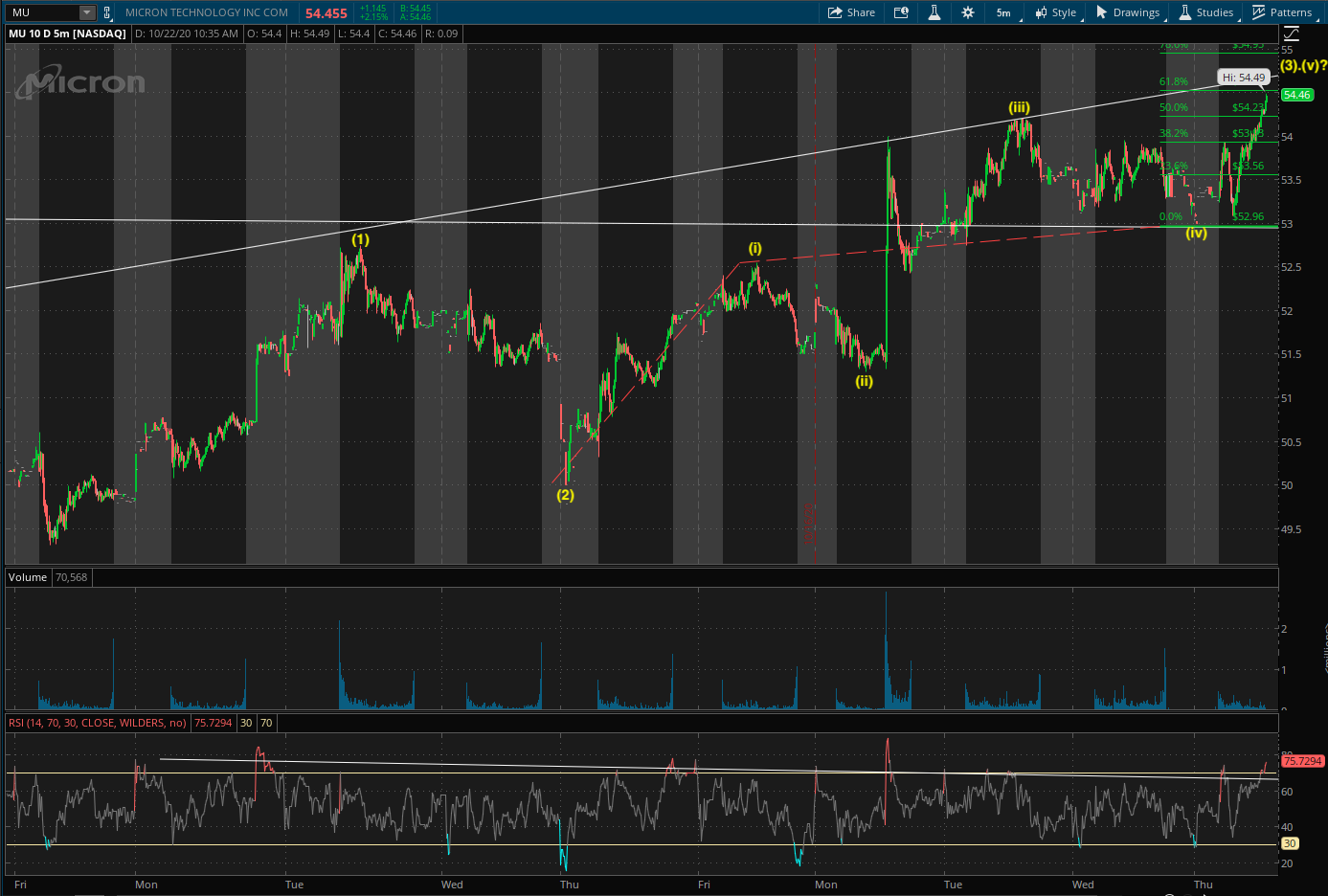
Screen Shot 2020-10-21 at 11.26.19 AM
Screen Shot 2020-10-21 at 11.26.28 AM
Screen Shot 2020-10-21 at 11.25.57 AM

Edit:

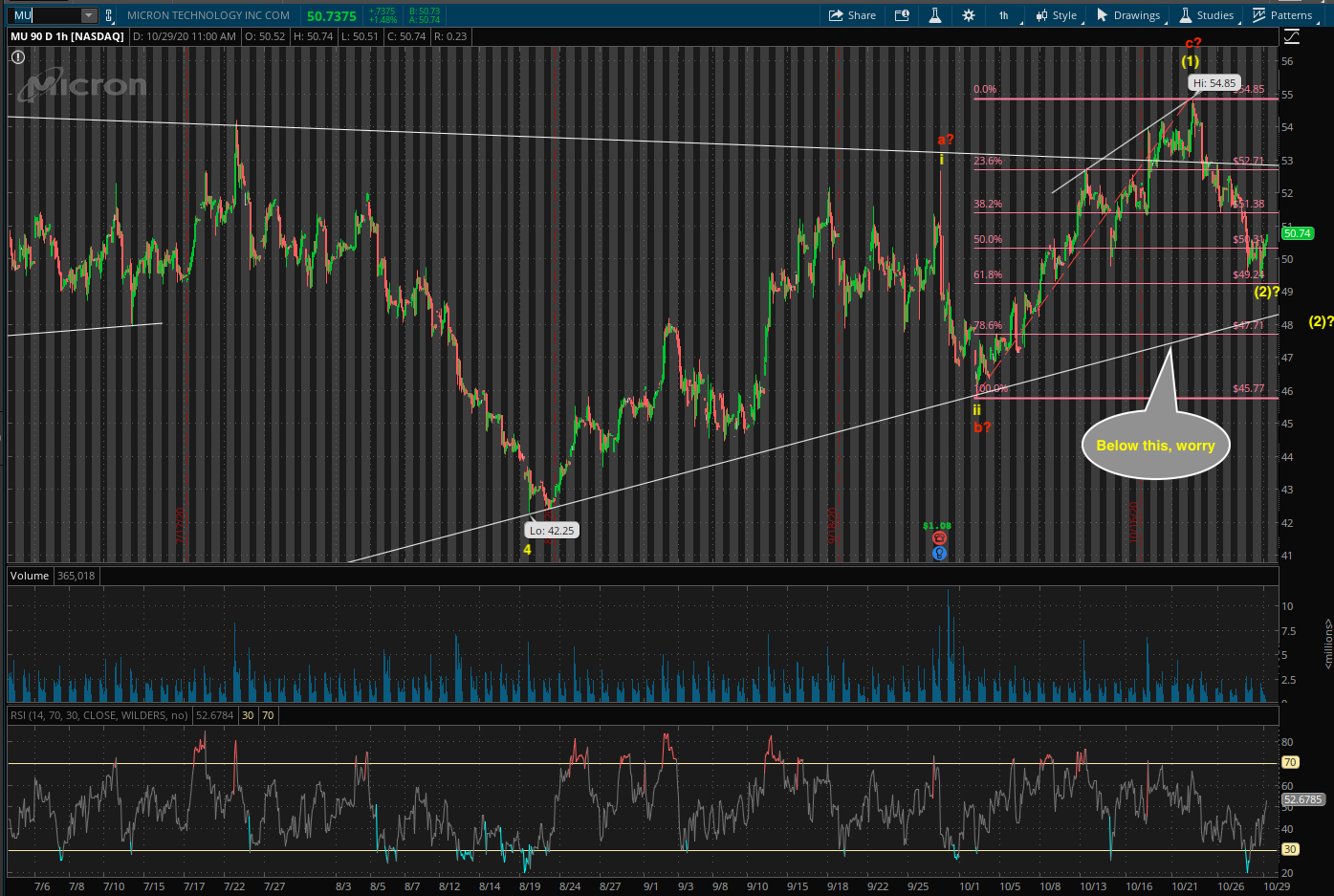
MU wavers so much that I’m not sure it is in a bullish impulse or a corrective wave zigzag. So call replace those 500 shares. Now holding 15 calls, almost ~100% cash :hugs: - no, not 100%, want to be IN no matter what :surfing_man:t2: not @Jil style.

Oh it does.


TOKYO – Yukio Sakamoto, a 73-year-old Japanese chipmaking business veteran, last fall took a senior vice president position at Tsinghua Unigroup, a leading Chinese high-tech conglomerate affiliated with the renowned Tsinghua University. His role is to oversee the launching of a DRAM memory-chip manufacturing business.

It looked like a bold decision and perhaps an ill-conceived move considering the U.S.-China technology rivalry was growing nastier. The U.S. continues to throw one punch after another at Chinese semiconductor makers Huawei Technology and Semiconductor Manufacturing International Corp., known as SMIC, making the idea of launching a new chipmaking business in China appear daunting.

But Sakamoto remains optimistic.

“We are living in a world where latecomers have a better chance to catch up with incumbent leaders,” he told Nikkei Asia, “because semiconductor technology is progressing more slowly today as the smallness of transistors is approaching limits in terms of physics and optics.”

He is not talking about the near-term conditions for building a new memory-chip factory, which are far from ideal. It is uncertain how long Chinese companies will be allowed to import U.S. chipmaking equipment and chip-designing software, though as of Oct. 19 Unigroup has not been named as a restriction target by any U.S. government agency.

Rather, Sakamoto is talking about the longer-term prospects for China to develop its own silicon wafer fabrication skills and technological capabilities for domestically supplying chipmaking materials, equipment and software.

History tells us that a technology paradigm shift can create opportunities for emerging players, and Sakamoto is seeing this unfold in the semiconductor sector today.

Rise of 3D tech

Moore’s Law remains on the books. It says that the number of transistors in an integrated-circuit chip doubles every 18 to 24 months. It was foretold by Intel co-founder Gordon Moore in the 1960s. Until the mid-2000s, the industry kept pace with the law by shrinking the size of transistors and circuits built on a surface of a silicon wafer die.

But miniaturization hit a wall about 15 years ago. The size of transistors had shrunk to about 30 nanometers (30 billionths of a meter), measured by the width of a central electrode called a “gate.” Therefore the speed of miniaturization slowed.

Chipmakers have nonetheless kept reducing the numbers labeling their latest generations of chips, going from 32nm to 22nm, to 14nm and to 10nm. But these numbers stopped representing actual transistor-gate sizes after the mid-2000s, becoming something like brand labels.

This is pretty long article. i post the first part. basically it is now about Sushi.

Look like jumping off too early. High probability that it would push to $55, pause, push to $60s. What to do? Buy back :sob:

ZM in. Friday hits $55? Today?

Xi should thank Trump. Have a good reason to push semi manufacturers to work harder to come out with chip equipment, chip design software, and chip manufacturing expertise. Instead of 4 years behind, should narrow pretty quickly in shorter time.

Intel bombed.

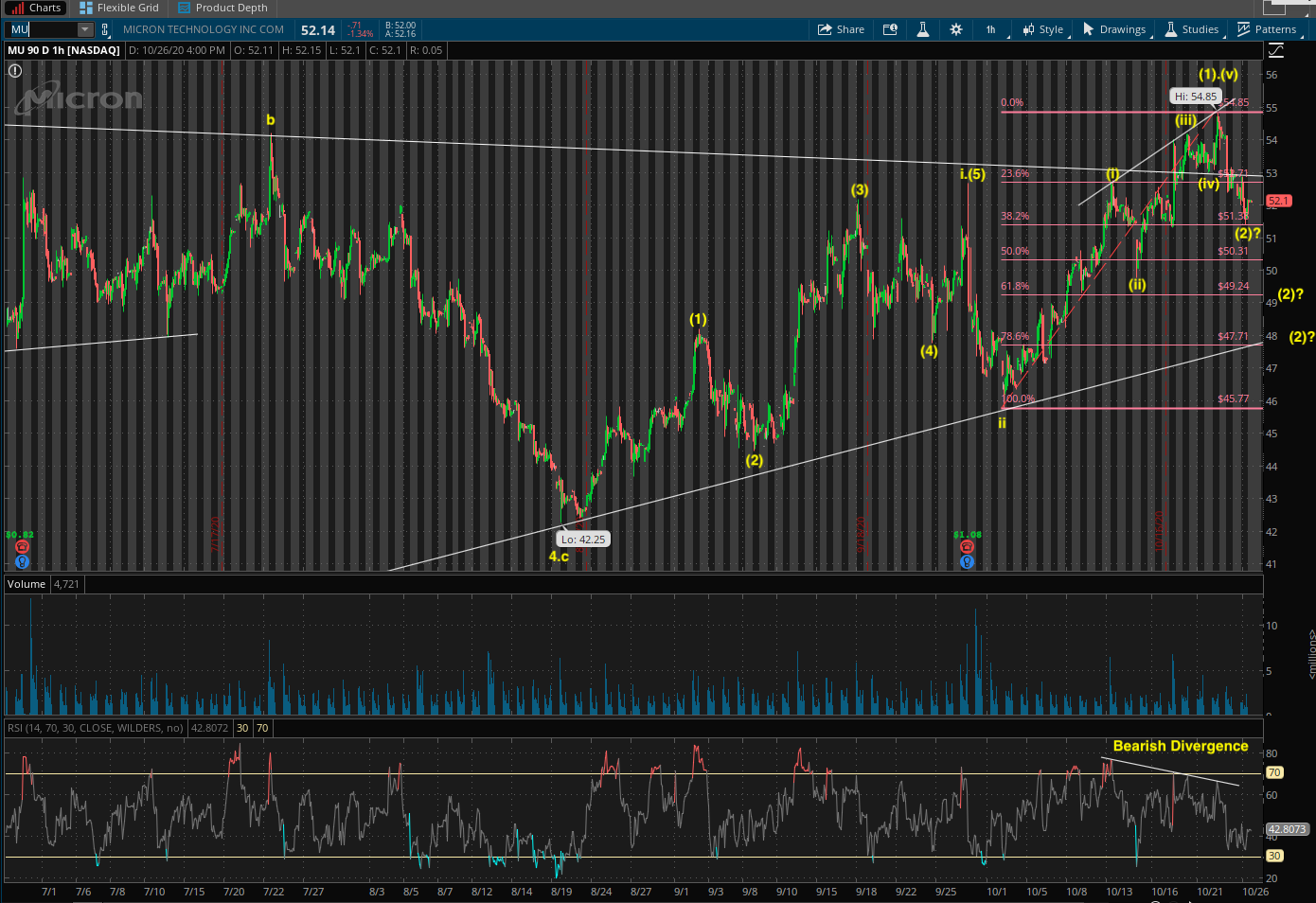
$54.85 yesterday.

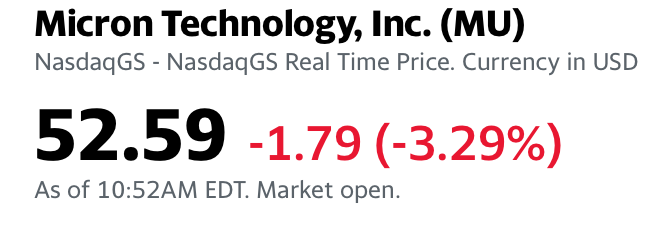
Just jump off few hours early :slight_smile: Down today.

Screen Shot 2020-10-23 at 9.52.40 AM

Day Trade Update:

$220 for 10 calls, how much can I make?

Took a gamble. Double to 30 calls :hugs: High probability that wave (2) is completed

@manch

Any comment on the articles below?

Why Micron Technology (MU) Stock is a Compelling Investment Case

Underwriting The Future + Micron Technology Bull Case

The U.S.-China Conflict Over Chips Is About to Get Uglier

The first big improvement in productivity came from the agricultural revolution, which allowed humans to shift from hunting and gathering into high productivity farming and the division of labor.

The second wave of human productivity came from the industrial revolution, which harnessed machines to perform repetitive tasks on our behalf.

We are now in the third wave of human productivity: the information age. Like the machines of the industrial revolution, silicon chips are now automating and simplifying information-driven tasks.

Each of these waves relied on certain enabling resources; those that had them thrived, and those that did not fell behind. In the agricultural revolution, the enabling resources were arable land and nutrient-rich grains. In the industrial revolution, it was fossil fuels. And in the information revolution, it is silicon chips.

Promising :slight_smile: Added 20 calls yesterday, now holding 50 calls, so long I’m right is i-ii-(1)-(2) and not abc, it doesn’t matter whether wave (2) is completed yet. The ensuing wave (3) of wave iii is a powerful uptrend wave :surfing_man:t2:

1 Like

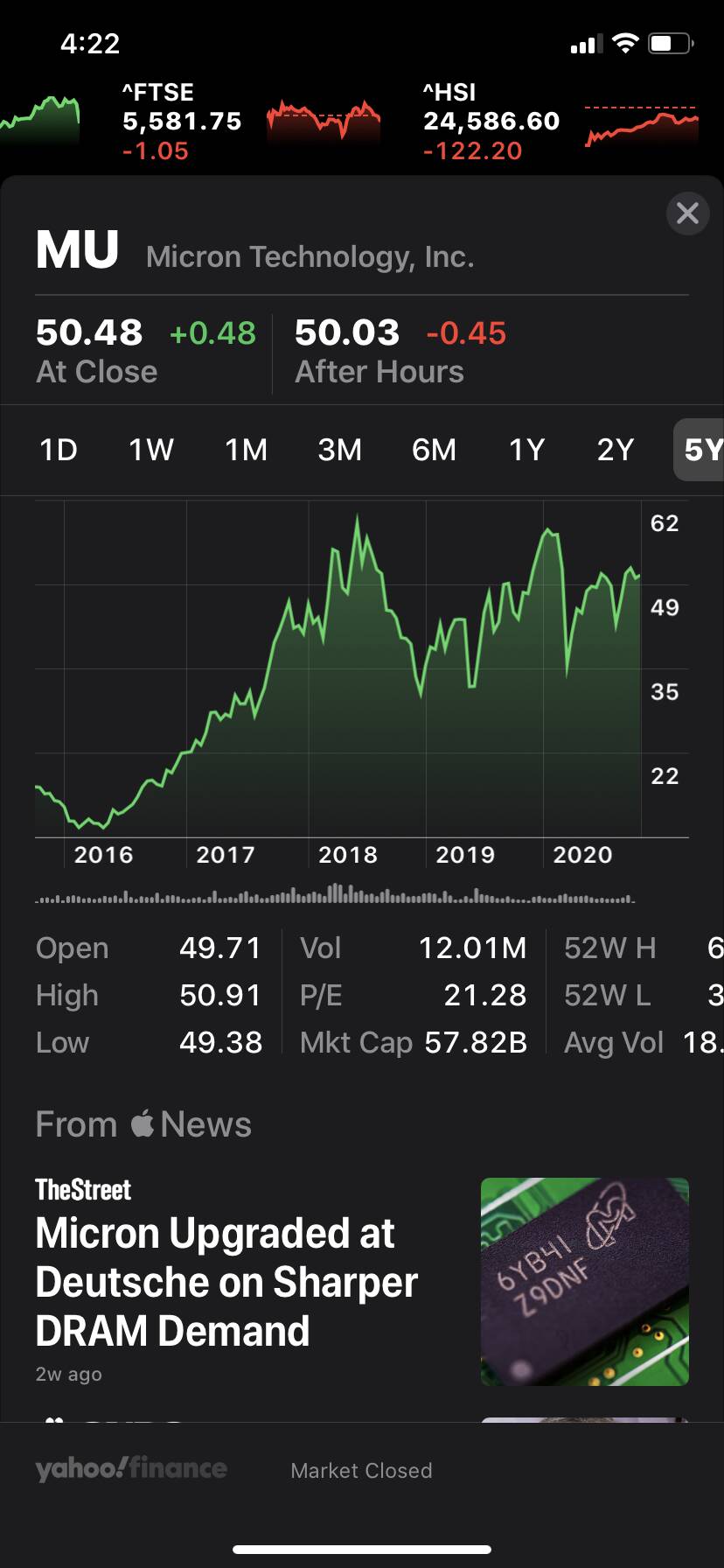
Why is Micron such a terrible investment. Still the value as two three years ago

Different strategy for different behavior.

Powerful impulse - long naked
Impulse - long/ short underlying
Sideways - short puts/ calls

Use your favorite TA to identify.

Using your idea that MU is the same value as 2-3 years ago, shorting LEAPS put would be profitable since it would diminish to zero over 2-3 years. Long underlying would yield zero return.

As for your image, refer to my post 5 hrs earlier.

I realize it’s us a gamblers stock. But why not pick one that actually goes up.

Here is the real world. There are huge supply line shortages. It is impossible to get parts. My friend owns a boat yard. They can’t even get props. 140 boats backed with 2-3 m order times. Impossible to find a new truck.

Trade what you know. Basic principle.

Actually MU is in a secular uptrend. Currently in a corrective wave of Primary to Cycle degree. Anyhoo, you need to understand EWT.

Only three players. And they no longer try to increase market share, hence no more excessive supply. And MU is the only American player.

You know Appl. It’s a winner Mu is a looser. Too much competition.

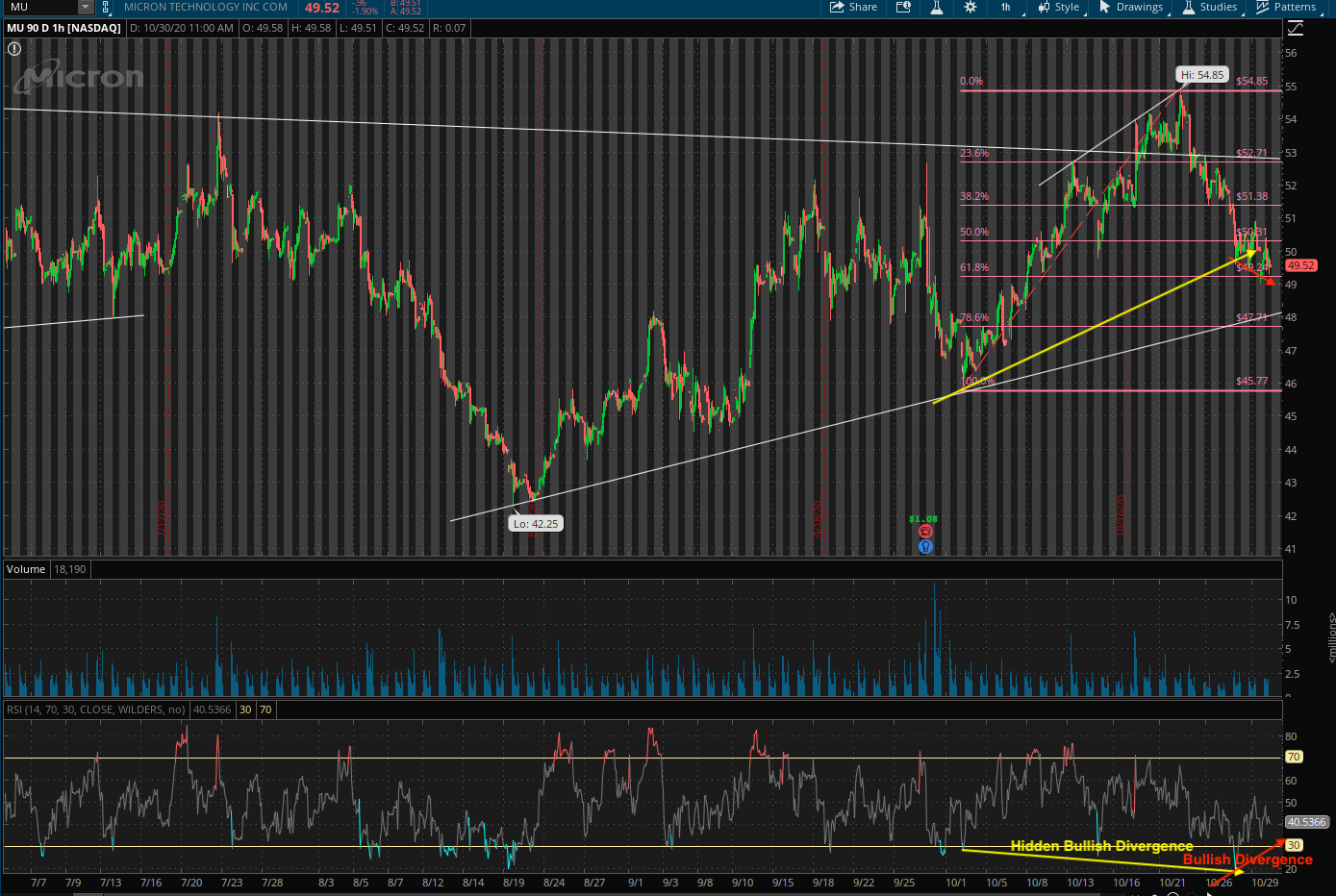
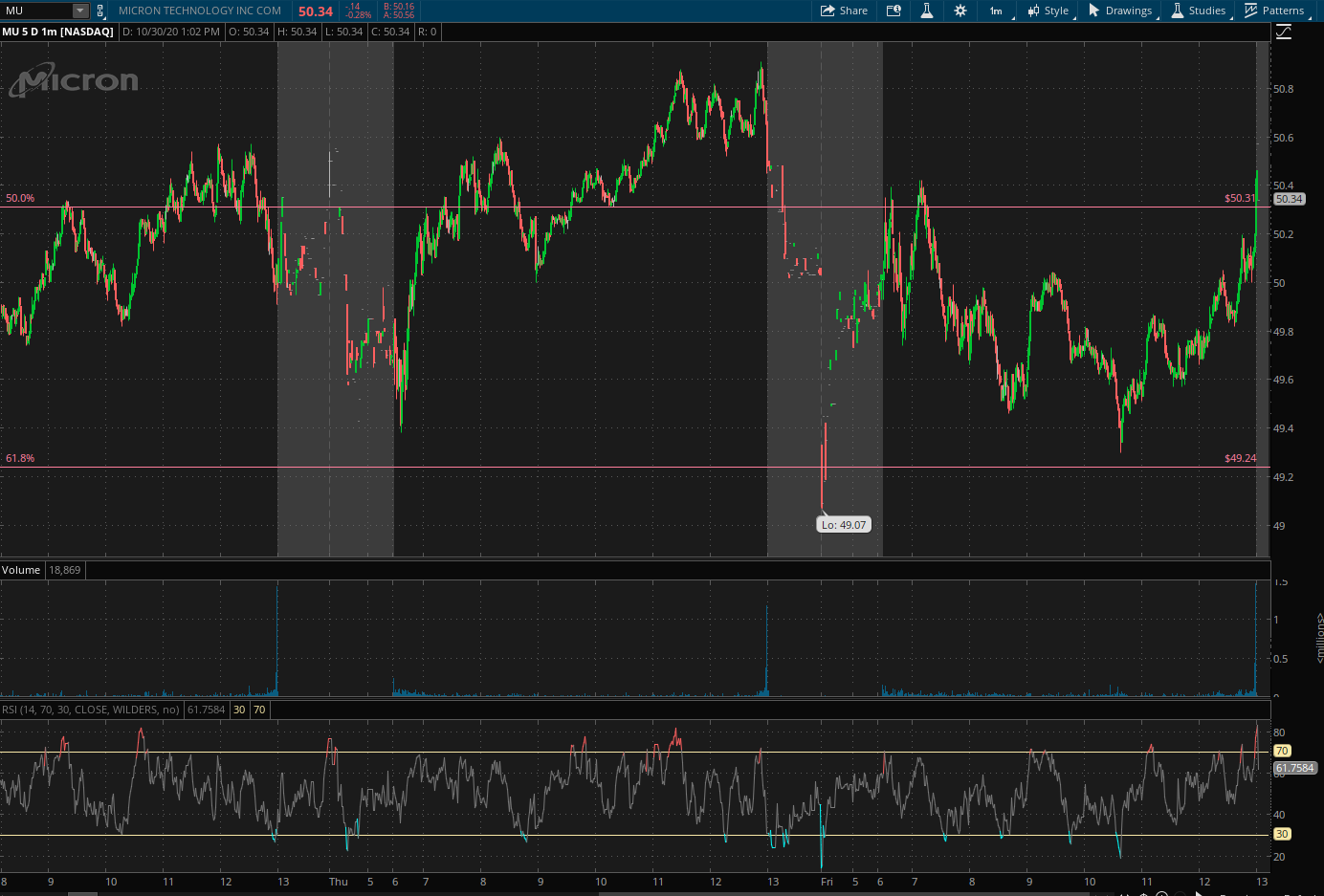
Look at MU. Self explanatory.

MU red today
The only green stock I watch is Carnival cruise line. The gun stocks are even red. So when the going gets tough, the tough go cruising?

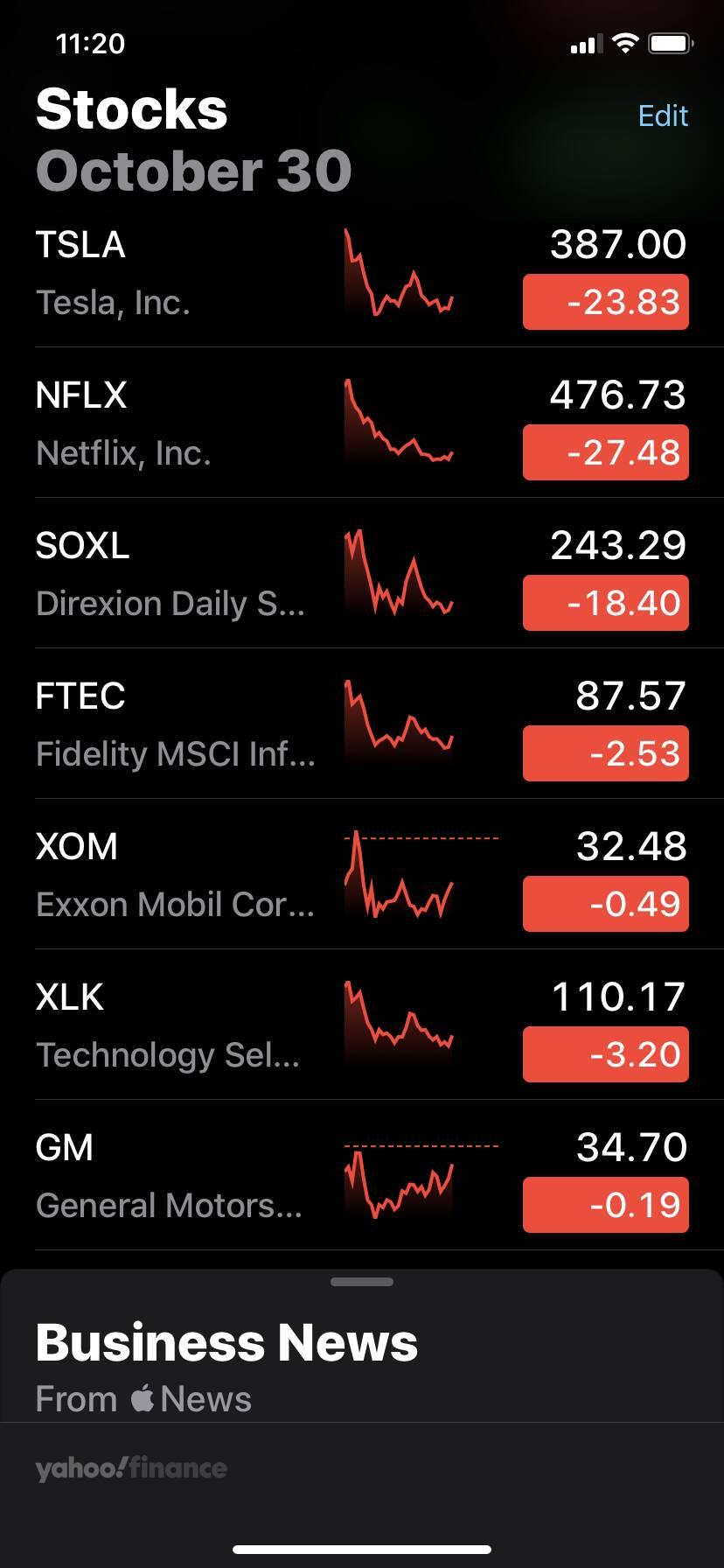
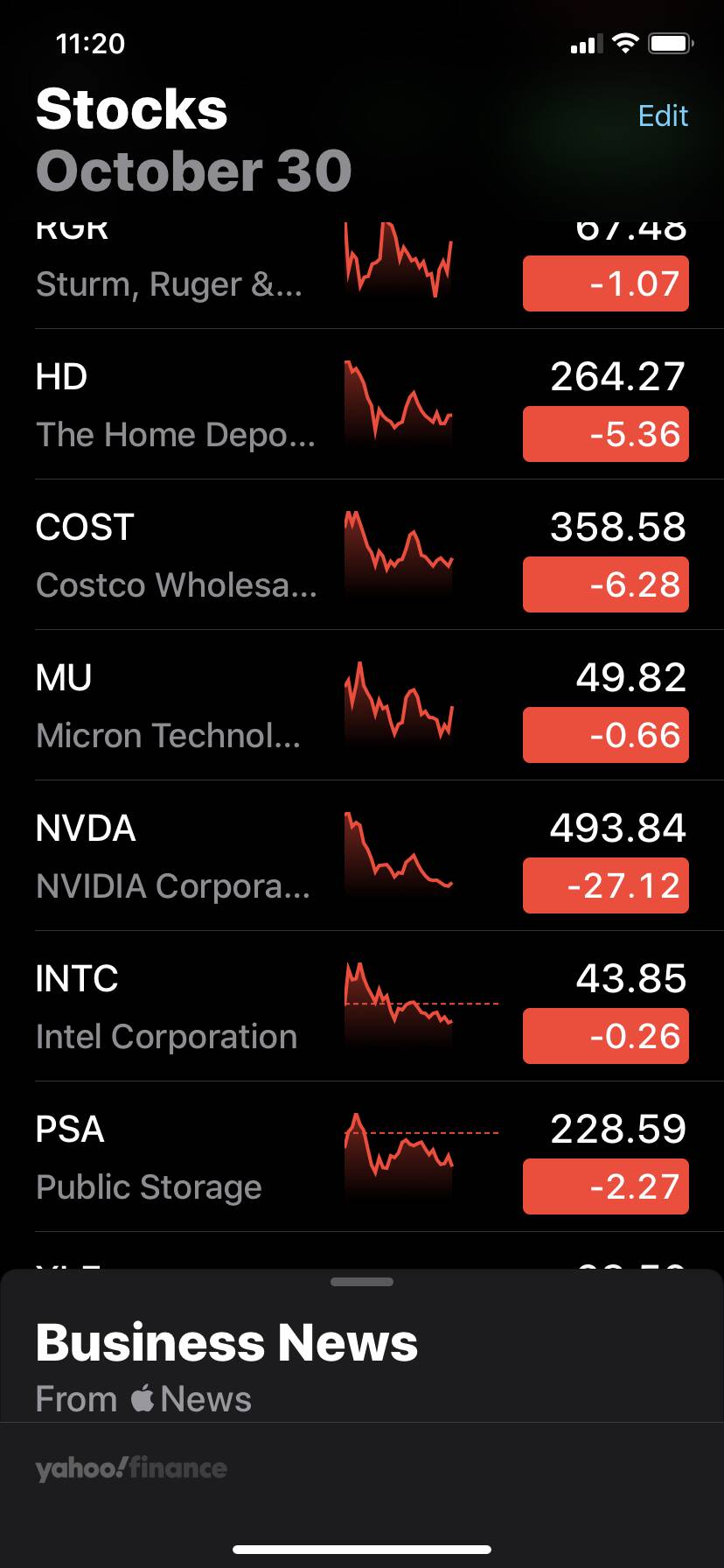
Some stocks I watch

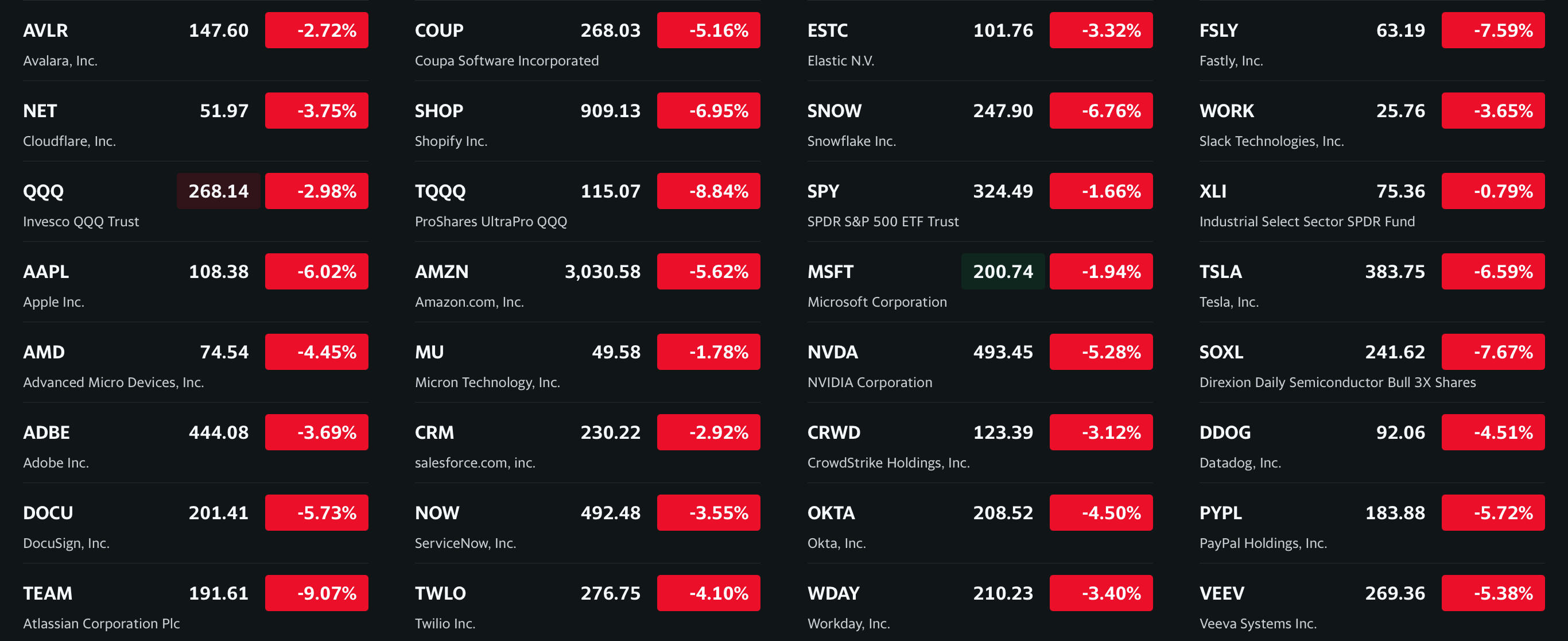
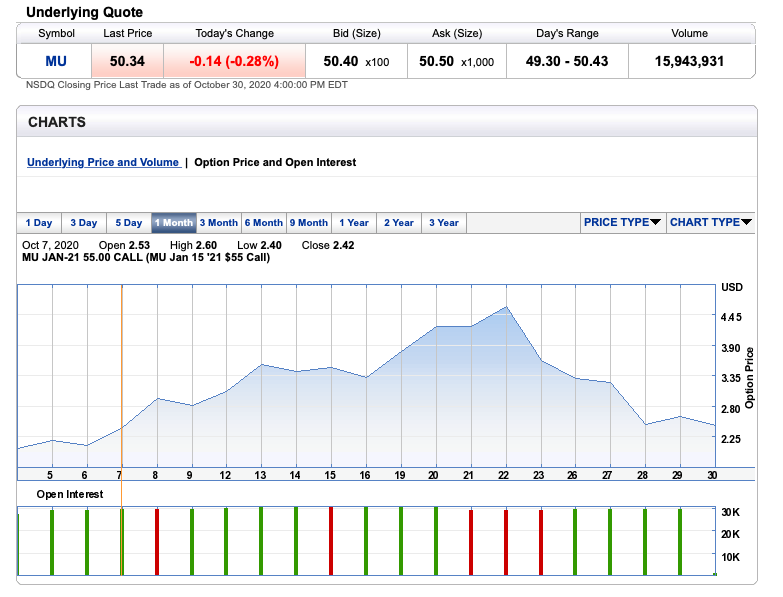
Self-explanatory chart below. Btw, worth of semi portfolio appreciates over yesterday’s close. MU rocks.
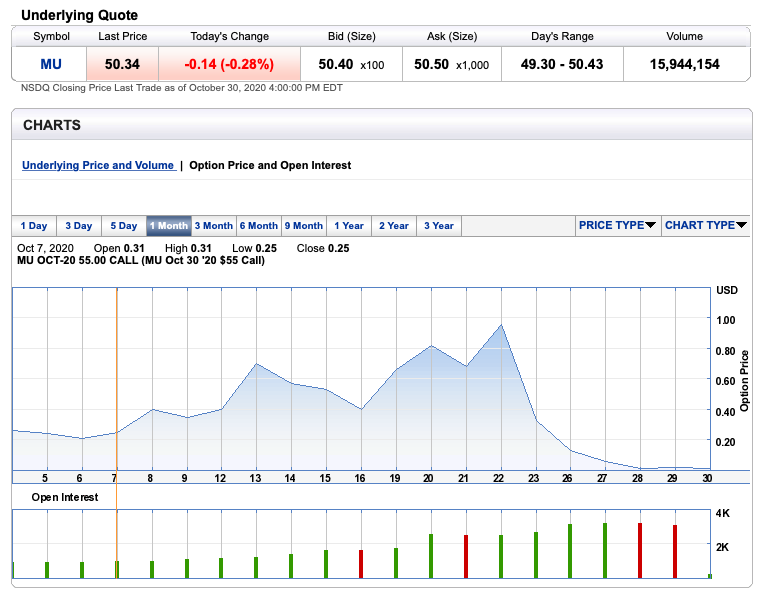
How is it possible? Because of calendars :slight_smile: My “calls” are actually calendars. The short calls (Oct 30) has gone to zero while the longer term calls is about the same.

A calendar is short a short-term call e.g. Oct 30, and long a long term call e.g. Jan 15, 2021. Say…

On Oct 7, you BTO a calendar (Jan 15/ Oct 30 $55) on Oct 7, you pay $2.17.
Today Oct 30 $55 call is worth zero. The Jan 15 $55 is worth $2.48. So you make $0.31 per call - gain 14% in less than a month. This type of strategy is suited for trading MU which is going nowhere or in EWT lingo, sideways.