Most teams have zero clue how to measure productivity. For decades, the measure has been how many hours a team spent at their desks. That’s honestly moronic. We ended up with a couple generations of executive leaders who got there by being in the office the longest. No one thought that maybe they’re working so many hours, because they aren’t competent enough. I’ve yet to see the mythical person that works 12 hour days and is performing 50% more work than their peers.
I see remote work as a huge equalizer where the outputs are measured more than hours at the desk.
This is an interesting piece. Conor argues because young people don’t have as much in-person networking and learning opportunities in a remote workplace, they should start strategizing their networking in high school and college.
And that means going to a private high school and a bigger college. Interesting take. Haven’t thought about it that way.
Hybrid is obvious. What is the ratio of WFH/ RTO days? Anecdotally, 2/3 is the popular choice. Guess depends on nature of the job and experience of the employees.
Have definitely noticed this the moment we started hiring only in SF. 1 or 2 standard deviations shift in the drive level of our candidates.
Remote candidate: “I’m really looking for a remote job because I wanna maximize time with my dog” (true story)
SF candidate: “I don’t care about the poop, I don’t care about the needles — something crazy’s going on over there and I’ll do anything to be a part of it.” (Also true story)
RTO is return to office period - (I support a hybrid model for sure). What people are still protesting is full remote - SF is the only city not back to normal - I was in NYC this past week and people were back out in person working, we’re the only place people feel entitled to wfh. It’s annoying and it’s not doing our downtown any favors.
Let companies decide, i.e. the entity that is paying the paychecks. And employees will also decide where to work. After employment is voluntary.
So what if ppl in NYC are working in downtown, why does that mean Bay Area or SF should do it too?
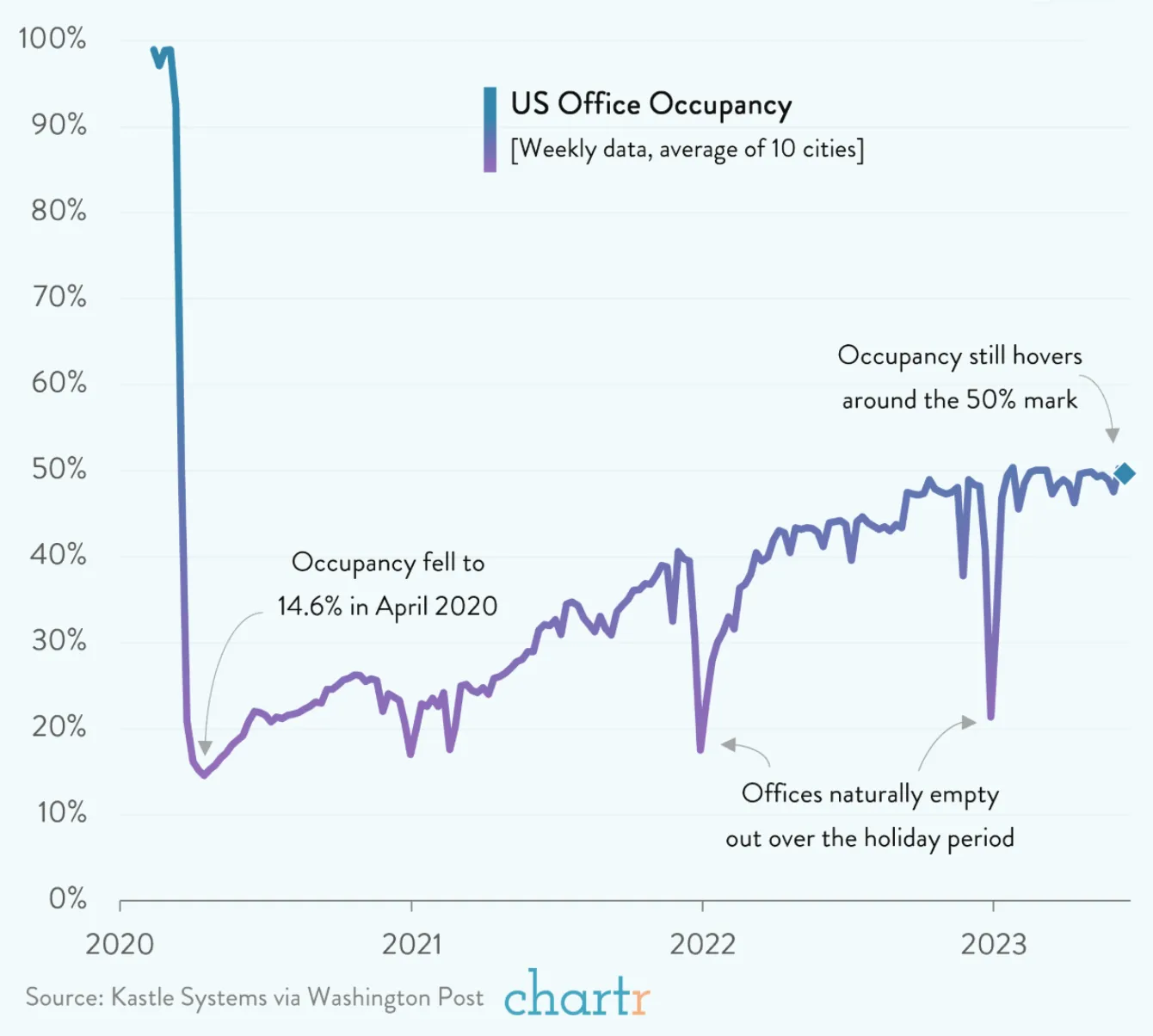
Btw the real data from June 2023 is this:
In New York, last week’s occupancy figure dropped to 49.1% from 50% a week earlier. San Francisco saw a modest bump over the same span, to 46.5% from 45.4%.
So, the difference is not as high as you perceive. It’s just @2.5% difference.
Nobody is entitled to anything, not the company, not the employees and not any downtown or any city.
Annoying to who and why?
Why should workers be beholden to any downtown? The work for the employer is getting done whether remote or hybrid, and they work for the employer not for some downtown.
The only ppl pissing in their pants are who have put tons of money in these employment centers who are scared that the valuation of their investments will get drastically reduced.
has seen its office-occupancy rate fall from 68% in early March to 57% last week — the biggest drop by far among the 10 major US cities tracked by security firm Kastle Systems.
The decline comes as Austin’s office-vacancy rate rose to 25% in the second quarter, according to Cushman & Wakefield, while space available for sublease has risen faster than any other metro area over the past year, CoStar Group Inc. found.
The Texas capital, where technology giants Google, IBM Corp. and Apple Inc. have ambitious expansion plans, has seen its office-occupancy rate fall from 68% in early March to 57% last week — the biggest drop by far among the 10 major US cities tracked by security firm Kastle Systems.
Don’t know how they calculate. In the morning, the traffic is as jammed as before the pandemic.