It’s convenience to just have it show up at your door.
Shouldn’t the normalization part be the responsibility of the “database” guy?
The way I look at it you should be the database user i.e. SQL+visualization +Regression +ML.
There are different databases with different owners, since it’s going across departments. No one has forced everyone into a common master data scheme. It’s what happens when every department picks their own tool, sets it up themselves, and you add in acquisitions. Stuff you’d think is simple like how many US employees are there has US, USA, and United States. Obviously that’s all the same country, but the data needs normalized to enable reporting.
You’re right. Ideally, someone else would do that, and I’d be a user of the database. In this case, that normalized database doesn’t exist and is a bottleneck for my work. I’m impatient, so I figured out how to build the database myself. Now I can get to my part.
When I did a demo of phase I, I was asked how I got the data. I wasn’t subtle about setting up a VM running SQL server on my laptop. That means no one else can access it except on the Power BI interface. That upset people enough that now they’ll build a copy of what I did on AWS for me 
It drives me nuts when I hear, “I don’t know how to do that.” I didn’t know how to do a bunch of parts of this when I started. I had been a consumer of databases not a builder of them. I also hadn’t used Power BI to create something. I didn’t even know what row-level security was.
2 Likes

Amazon is investing big in their fulfillment network to expand same-day shipping. That’s what a Day-One company should do. I actually feel better owning their stocks knowing they are still making big bets.
That shows how capital intensive logistics is. You think Shopify has the wherewithal to follow suit?
Don’t understand the toy like Unix box guys underestimates the toy PC manufacturers.
To successfully attack with a toy, you need to come at an asymmetric angle, sort of like a guerilla. You can’t expect to win a frontal attack of a tank with a toy gun.
It started off with tools for building Ecommerce websites  Obviously a better mousetrap than NEXT WebObjects. SJ is too early as usual.
Got 1 AMZN@$1388, doesn’t look like it is declining that low for me to add!
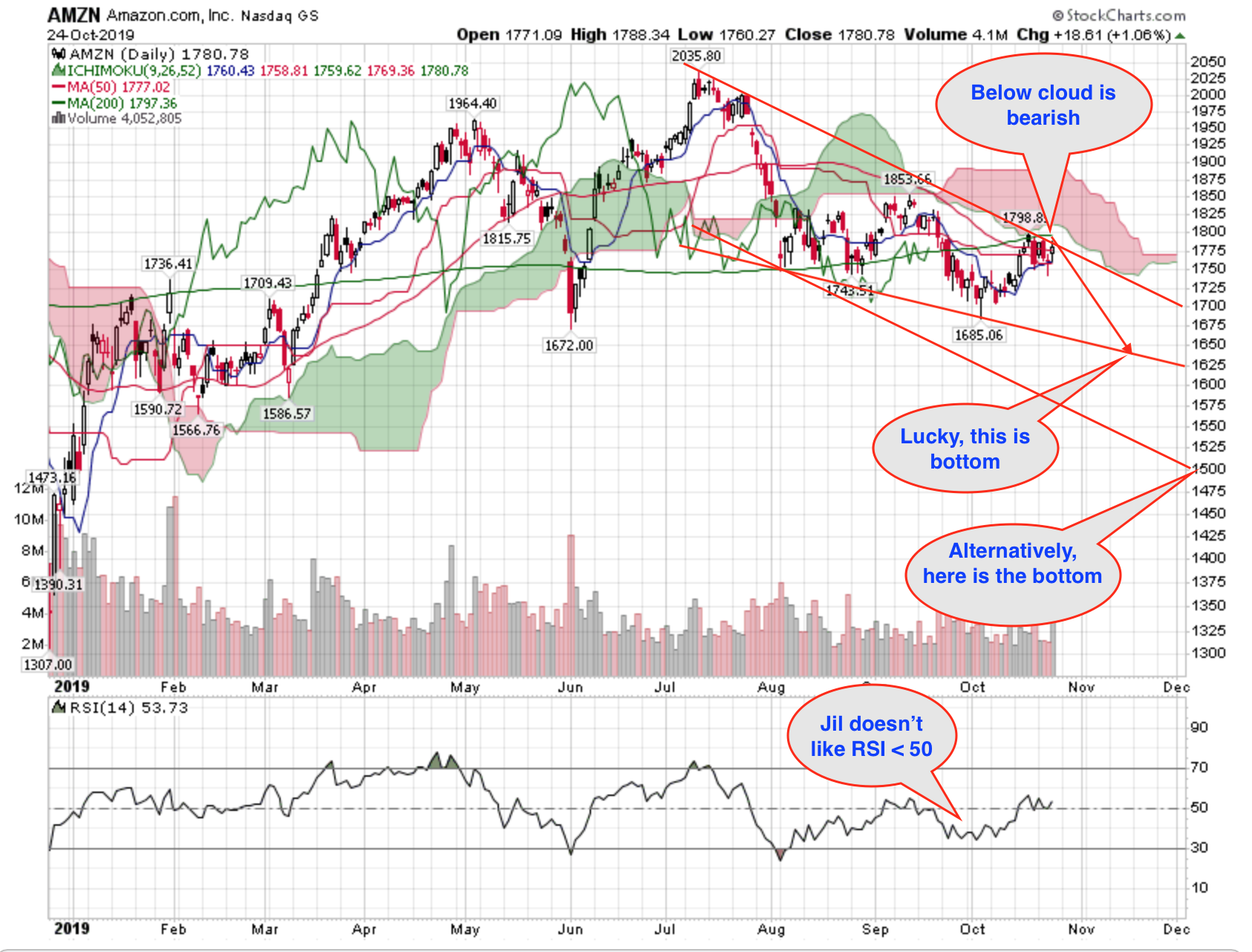
Oh !!! hold on, I bought AMZN after hours $1656, catching the knife as usual ! Fundamentals are good, people taking profit with minor miss.
With year-end is coming, peak traffic will be on AMZN site, next quarter zoom mostly. Any drop in AMZN is an opportunity.
I do trading, no holding…
Jil like RSI < 50, correct your statement. I buy only when it is RSI below 40.
BTW: IIRC, I said “Do not buy above 50 RSI”
Someone did an analysis that showed 70% of the extra inventory for 1-day delivery wasn’t going to 1-day capable fulfillment centers. There are only xx ones that’s are 1-day capable. They are the ones with Amazon robotics near major cities. Whoever setup the ML for inventory placement didn’t provide the right inputs. The inventory was mostly going to other fulfillment centers. No one seemed concerned about it.
AMZL is still too expensive.
The other issue is more and more people shop via the app. The result is fewer items per order and more orders. That leads to higher shopping costs per item. The cost of 4 items in 1 delivery is much lower than 2 orders of 2 items.
1 Like
Exactly what I did. Free shipping, 1 item is a go, no need for more items.
@manch See, @marcus335 also think is too expensive 
More expensive than SHOP? 
Both are expensive. AMZN is passe’. SHOP is in.
Lol, you edited. AMZL which is the delivery service is still too expensive. It’s actually a pretty big cost penalty vs other delivery providers. There is the promise that at scale it will be cheaper, but that hasn’t been proven yet. Right now, AMZL is more expensive and hurting the bottom line.
Hurrrraaaay, catching knife works, holding another 20 days.
The narrative is one-day delivery is supposed to increase the growth rate. It’s not. That means one-day delivery is adding costs without adding any sales. That’ll permanently hurt margins.
Retail is just a side show though. The bigger story is AWS growth is slowing. Azure is growing by 59% vs 35% for AWS. It’s not quite apples-apples, since Azure includes some other stuff. It’s not a brewer trend though.
Amazon is at least smarter about changing businesses than just about anyone else. It’ll cut headcount budgets for businesses that aren’t growing fast enough. That’ll force a re-balance if employees into higher growth areas. People who can’t land a new role are pushed out.
It’s honestly amazing compared to most companies approach of baseline plus a percentage increase for budgets. With the baseline approach, you end up with grossly over staffed product teams as markets shift.
I’m trying to implement a more amazon approach for next year based on addressable market size and revenue growth rate of products. Time will tell if we have the guts to see through re-balancing teams.
3 Likes