I am still learning those too since my kid is still in 2nd grade. Did you also explore Russian Math? I found it quite interesting close to common core but more challenging. It drills on good understanding and how you can solve larger problem by breaking down instead of memorization (which is the system we grew up with)
1 Like
This is one area I did not want to discusses. But, I am curious what 8x9 means (according to common core) . And how it is different from 40 + 32.
the idea is that do we want math to looks like story of 6 blind men explaining an elephant?
No, I did not. Did you get a tutor or some other online resources? I saw some tutorial centers here in the City advertising Russian math.
For me personally, countering the extremely harmful mindset of math as an inborn ability is more important. It’s something I don’t see back in Asia growing up. For us, if you suck at something, that just means you need to eat more bitterness and work harder. Here in the US, people believe either you are born with the “math gene” or you are not. Nothing you can do.
This old piece explains it well:
That’s doubly harmful for girls. Popular culture and common beliefs among people is that girls are worse at math than boys. On the other hand, another stereotype is that Asians are good at math. So maybe for us the two balance out somewhat? Still I don’t like it one bit.
1 Like
Common core math is too many word problems too early. Kids need to get the arithmetic skills first, then apply them to solving problems later. This is likely why the Chinese parents are upset. They want to see their kid be able to do the math quickly, and instead a lot of kids are still memorizing their multiplication tables by middle school because they spent too much of elementary school trying to figure out which numbers needed to be pulled out of the word problem to multiply.
I remember someone once told me Indian kids are taught to memorize multiplication tables up to 12x12? Or is it 24x24? Don’t remember.
I think nowadays 5x5 is adequate. Anything more you just pull out your phone.
I was surprised to see my kid do 8x9 by first doing 8x10 and then subtract an 8. I like the fact that she understands what multiplication really is.
At our school, they memorize up to 12x12.
I have witnessed similar strategies in 3rd grade, for numbers > 10.
1 Like
Thinking among the left leaning academics and pedagogues is that if Greta Thunberg can become a climate scientist at age 11 and solve complex climate issues then why cannot a kid at age 5 comprehend text and translate into a mathematical equation.
Funny to see how the meaning of maths and science these days is no longer what it is supposed to be. That is why pretty much everything is called science these days even if it is based upon pure conjectures and hearsay.
1 Like
Talking of rote memorization, my dad learned multiplication tables starting from 1/4 , 1/2 , 1, 2, through 30
1 Like
We sent them to Russian School of Math (RSM) in Mountain View. Personally I just want the material but we couldn’t find them online or able to buy the book.
3 Likes
2 Likes
The new rules are ridiculous. Retaking Algebra 1 is not a crime. It’s better to have earlier access to it - more practice on the material then. Claiming that the new 8th grade math is Algebra 1 in disguise, so everything’s ok makes it even more ridiculous. If it’s Alg 1 in disguise, then just call it that.
Squaring Up to Defend Mathematics
America’s top scientists warn about the political erosion of education standards.
1 Like
5x5 should be done by Kindergarten.
Every kid needs to memorize 10x10. Every math problem derives from that. Pulling out a calculator in class because you can’t figure out 8x8 means you are losing valuable class time.
3 Likes
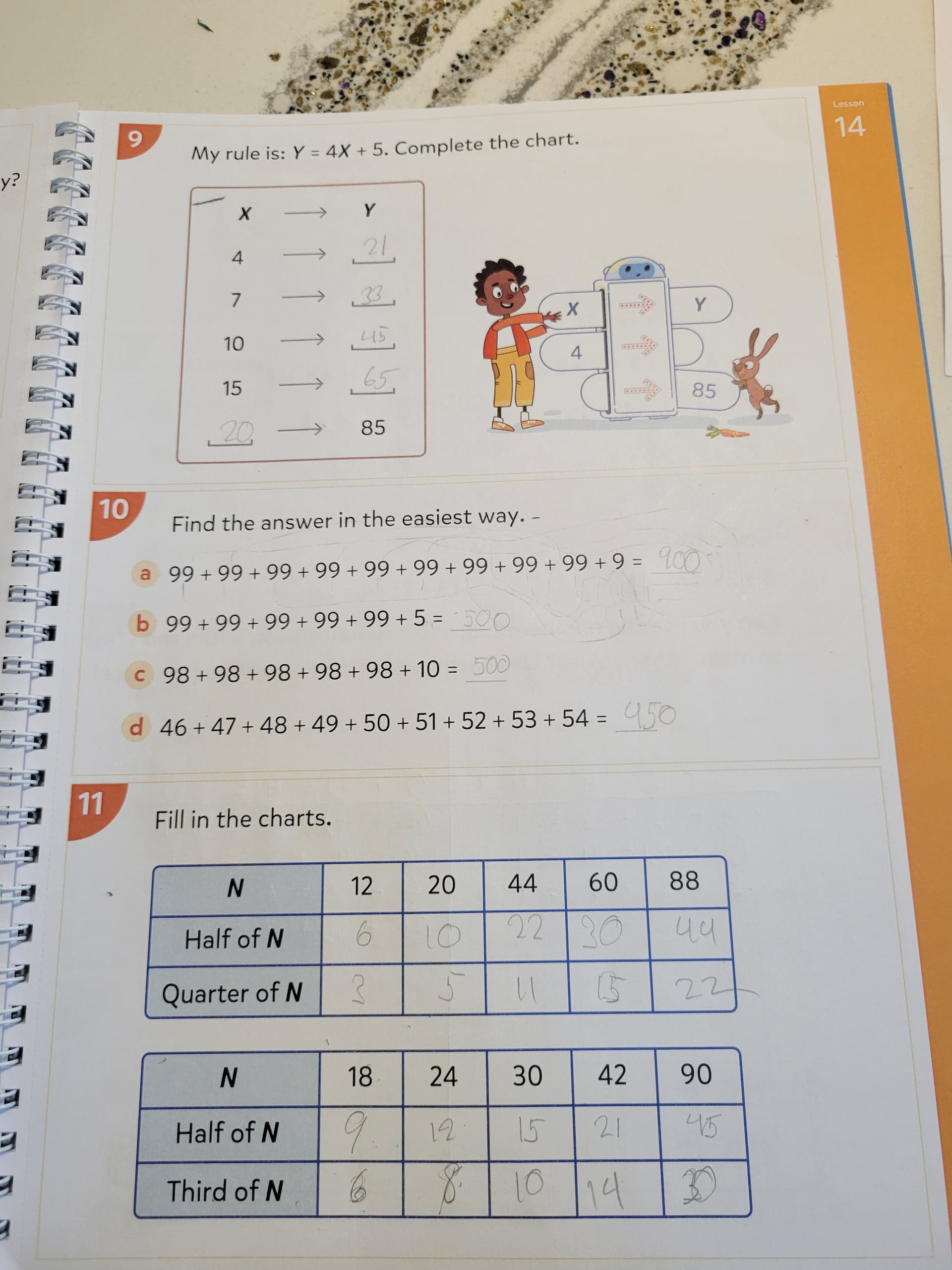
This kind of stuff is very useful. Especially part 10. It helps with being able to visualize numbers combining.
1 Like
Standards for 2nd grade math are straightforward:
How often does a kid need to figure out 8x8? Squares are easy. Maybe a more relevant question is how often does a kid need to figure out something like 6x8? As part of a bigger problem.
I think Part 10 looks like some of the problems my kid showed me. Maybe not as long but she learned some tricks to tackle digits close to a round 10.
Not sure if she learned how to tackle summing consecutive numbers.
The half and quarter part looks familiar too. It looks like Russian math is a more advanced version of common core?
That’s what I felt too. At least Russian Math is in the similar path with common core, a bit more advanced, but kids can reuse the things they learn from either approach. I checked out Singapore Math (books can be bought on Amazon), it is quite interesting too but they more focused on creative solution than technical / strategy like Russian math. My thoughts are from very limited exposure.
1 Like
Feynman vs. The Abacus:
https://www.ee.ryerson.ca/~elf/abacus/feynman.html
My wife asked me a few months back if we should sign our kids for abacus school. I said HELL NO. That’s not math. That’s just finger exercises.