
This is perfect esp first sentence. Money must be earned involves work and effort.
1 Like
PacBio Doubles Down on Sequencing Accuracy by Acquiring Omniome
By Simon Barnett
Analyst
Earlier this week, Pacific Biosciences (PACB), the leading provider of highly accurate long-read sequencing technology, acquired Omniome in a $600 million cash and equity deal. Omniome pioneered a short-read sequencing technology called Sequencing-by-Binding (SBB) that generates sequence data with accuracy more than an order of magnitude greater than the current short-read status quo. This acquisition could cement Pacific Biosciences’ position as the premier provider of high-fidelity solutions for the genomic sequencing market.
Reportedly, China Is Forcing After-School Tutoring Companies to Shift from For-Profit to Nonprofit Entities
By Yulong Cui
Analyst
On Friday, Chinese local media and Bloomberg reported that China is considering turning after-school-tutoring (AST) companies into nonprofit entities as part of its “Double Reduction” education policy reforms. “Double Reduction” refers to the load of homework and AST entrance exam preparation that students bear. Since China issued direction for such policy reforms in May, local media has reported on the potential changes, among them prohibiting tutoring during weekends and summer/winter vacations, banning advertising for tutoring services, and establishing a special entity to oversee AST companies. Prior to their plummet on Friday, these reports already had hit Chinese AST stocks by over 50% in some cases.
Among the likely reasons for these reforms are China’s focus on education as a key strategic priority, the excessive workload of tutoring on students, and the rising cost burden on parents, not to mention reportedly corrupt business dealings favoring wealthy families behind the scenes. If implemented, the changes could improve the quality of life for students and lower costs for parents, an increasingly important consideration given China’s demographic concerns and its new three-child policy.
We believe the tradeoffs associated with China’s new policies include the significant cost to existing investors in the AST space which seems to be fomenting more broad-based shareholder fears, and a loss of innovation in the education space. After years of capital flows accruing to its benefit, given these recent moves China could be risking the capital flight of foreigners.
Is the Call Center Dying?
By William Summerlin
Analyst
Last Sunday, Zoom made headlines when it announced an agreement to acquire cloud call center software provider Five9. Call center software has been a notable exception in the move to broad-based cloud adoption. As of September 2020, only 10% of call centers were in the cloud, according to industry analysts.
The COVID crisis, however, has changed this dynamic and catalyzed call center migration to the cloud. Working from home, agents couldn’t route calls through legacy on-prem software. Indeed, now that many companies have moved permanently to remote or hybrid work policies, the acceleration towards cloud is likely to continue.
Now we wonder if traditional call centers will continue to exist as artificial intelligence automates support tasks? Two trends suggest that they will phase out over time.
The first trend is the move from voice to text as the primary channel of communication with customers. Text-based communication allows support agents to handle requests asynchronously, mitigating connectivity issues in remote work environments and supporting automation more naturally than voice. Moreover, Millennials and Gen Zs seem to prefer text over voice.
The second trend is the automation of support tasks, removing humans from the loop. According to data from Five9, companies spend more than $230 billion annually on call centers, labor accounting for most of the cost. Based on our conversations with industry experts, the annual labor churn rate in call centers is 40%-60% annually, creating powerful economic incentives to automate customer support tasks. Forward-thinking software providers like Twilio and LivePerson are removing humans from the loop and, at the same time, improving customer experience with natural language understanding models that can converse with customers while modeling intent. Unlike the simplistic automated tree menu models we all despise - “Say ‘Pay Bill’ to make a payment” - advanced natural language understanding models gauge intent with surprising accuracy.
While call centers are unlikely to disappear in the next decade, we believe the move to text and automation should reduce support costs significantly as spending shifts from labor to software, improving the customer experience markedly.
Unity had a great day. Up almost 8%.
I think this one is foundational to future platforms and has a nice moat.
2 Likes
28B market cap. Can’t believe Zuck let this slipped thru.
The $22.4 billion ARKK fund is down 7.1% for July so far, putting it in the bottom 96th percentile rank among the 605 mid-cap growth funds tracked by Morningstar. At the same time, the S&P 500, with its heavy weighting in big technology-focused stocks, is up 2.4%, helped by a 5.8% gain in Apple Inc and a nearly 12% gain in Google parent Alphabet Inc. The fund is down 2.5% this year, compared with a 17.1% gain for the S&P.
Cathie’s prejudice is megcaps are not innovative and won’t have annualized return more than 15%. Sound like some1 here.
Beike (BEKE), Meituan (3690 HK), Pinduoduo (PDD), and Boss Zhipin (BZ)
Beike (BEKE) and Meituan (3690 HK) declined more than 27% and 17% on Monday and Tuesday, respectively, while Pinduoduo (PDD) and Boss Zhipin (BZ) both rebounded by 15% on Wednesday after having sold off less than 15% on Monday. Chinese stocks sold off broadly after the central government confirmed its directive, among others, to turn after school tutoring companies into non-profit entities. The degree of regulatory intervention has unnerved existing investors and weakened new investor appetite in Chinese stocks.
ARK’s investment team has been monitoring closely both political activity in China and the continued political tension between the United States and China. The Chinese government’s actions against any entity challenging its power, especially those with sensitive personal and other data, is impacting our scoring system, particularly the ‘thesis risk’ associated with most pure play Chinese technology companies and the revenue base of non-Chinese companies with business in China. While we believe that China still is placing a high priority on innovation, in the short-term its government appears to be more focused on equalizing the distribution of wealth and opportunities as it moves to address negative demographic trends with policy measures like its new “three child policy”. ARK’s investment team will continue to monitor this rapidly evolving situation, evaluating the mid- to long-term impact of China’s moves on various companies and securities.
LendingClub (LC)
LendingClub (LC), a fintech offering a range of online financial products and services, traded up 48% on Thursday after releasing second quarter earnings and trouncing consensus expectations. On the heels of acquiring a bank, the company posted sequential revenue growth of 93%, driven by higher origination fees and net interest income.
Pinterest (PINS)
Pinterest (PINS) traded down 18% today after reporting a sequential decrease in monthly active users (MAUs). Although it did report that MAUs dropped 24 million sequentially to 454 million, Pinterest also reported a 125% year-on-year increase in revenue and higher-than-consensus metrics across revenue, average revenue per user (ARPU), and earnings. Although we believe reopening dynamics in a post-COVID environment may have contributed to the lower retention of users, continued growth in its mobile user base highlights Pinterest’s high level of engagement in a mobile-first world. Pinterest is a social media platform company that encourages users to discover from each other items of interest or sources of inspiration, suggesting that it could become a prime beneficiary of the shift toward social commerce.
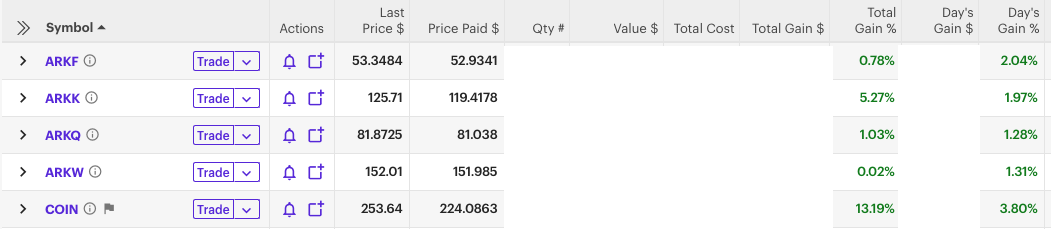
She buy HOOD? Just dropped $10
Stocks have no reason to keep going up, but what is the USP of HOOD? In other words, what does if offer that others cannot cheaply?
.
Most of her stocks declined a lot. She doesn’t believe in obvious FANGMANT (except TSLA) and very hot stocks like CRWD DDOG NET… (except SQ SHOP) which are making new ATHs. Early signs that her stocks are reversing.
To be fair to her, she calls her fund innovation fund. So, I do not know if FAANG companies can still be called innovating companies after 20+ years of existence. Is TESLA a company that is innovating still?
I don’t know about Cathie Wood’s portfolio, but looks like the breakout of Delta variant Covid has lit a fresh fire under NASDAQ. QQQ and TQQQ are up bigly today. Money is again coming out of the old Dow reopening stocks and going into Tech stocks.
Battery Cost Declines are Driving “Good Deflation” in the Auto Industry
By Sam Korus
Analyst
ARK’s research features regularly the “good deflation” associated with technologically enabled innovation. Battery cost declines, for example, are central to our electric vehicle (EV) forecast. This week, Nissan provided a great example of good deflation when it unveiled its 2022 Leaf EV. As background, Nissan priced its 30 kilowatt-hour (kWh) Nissan Leaf at ~$39,000 in today’s dollars in 2016. Five years later, it has priced the 2022 40 kWh Leaf at $27,400, $11,600 less for an additional 42 miles of range.
Another source of auto deflation - “bad deflation” - could be brewing in the used vehicle market. The Manheim Used Vehicle Index appears to have peaked in May, the decline accelerating during the last few weeks of July, as shown here.

While we believe the decline in battery costs is likely to translate into lower prices, boosting EV sales, the drop in used car prices could be signaling weakening demand for traditional gas-powered cars. Auto manufacturers have attributed the 20% drop in US sales from 18.5 million at a seasonally adjusted annual rate (SAAR) in April to 14.75 million in July to supply chain shortages, particularly chips. At the margin, the Manheim Index seems to be telling a different story. If underlying auto demand is beginning to weaken, traditional automakers could be in a difficult position.
1 Like
Deere Buys an Autonomous Tractor Company
By Tasha Keeney
Analyst
In its push to build fully autonomous farm machines, Deere acquired Bear Flag Robotics, an autonomous tractor company. Bear Flag builds autonomous systems that retrofit existing tractors so that a single operator can control a fleet of tractors remotely.
Autonomous machinery should boost farm productivity, much like the original tractor did, lowering labor’s share of farming costs, while boosting real farm wages. Indeed, automation can turn “non-market” activity into real GDP. A farm owner who currently operates her own tractor, for example, could pay for autonomous tractor service per acre, lowering her own time in the field, time for which she may not be paid explicitly.
As autonomous electric technology transforms machines of all types, ARK expects a proliferation of form factors. While they build tractors that conform to human drivers today, Deere and other companies could transform autonomous tractors and other machines into many shapes and sizes depending on their use cases. Bear Flag’s system fits into existing tractors today, but we wonder if autonomous tractors will be smaller machines working in tandem with drones and other robots in the future.