Climate Change

A total of 1,609 scientists and professionals from around the world have signed the declaration, including 321 from the United States.

No doubt there are scientists who disagree. That’s fine. Reason why I keep saying “consensus”. What do the vast majority of climate scientists think?

But to characterize all 1609 signatories as “scientists” is misleading. The piece itself says there are “professionals” in the mix. Who knows what their professional training is that gives them such a high confidence to opine on a scientific issue in public.

When the consensus on climate changed I am ready to change. I don’t have any horse in the race. Frankly I find it odd so many attach such high emotions to a scientific issue. I just defer to the scientific consensus.

Consensus was the earth is flat for how long? People cling to things regardless of new evidence.

I specifically said consensus of scientists in the field. I don’t care much about consensus of random Joes and Janes.

Because it’s an economic issue as well as a scientific one. Easy to ignore the economics if you’re not poor. There’s a reason India and China basically told the rest of the world to pound sand at Glasgow even though they are collectively responsible for 40% of global emissions while the US is responsible for 14%.

1 Like

These are two separate issues.

One is whether climate change is real. That’s a scientific issue. I defer to the scientists in the field.

The other is how should we respond. That’s a policy issue. We all have a say in that. You don’t need to say climate change is a hoax in order to disagree with the policy response.

The climate will never be constant. There are far too many variables. Pretending human made CO2 is the main one is just ignorant. It’s ok though. The earth is flat.

1 Like

Wow. What a great insight. The climate will never be constant. I am sure those scientists with PhD’s in their titles did not know that.

:rofl:

You’re the one that insists on debating if the climate is actually changing. You’re literally the only one here debating that.

You can analyze statistics and read a chart. Why would you defer to scientists? And how do you choose which scientists to defer to? You could just go with majority view but that isn’t really how science is practiced. True science constantly questions the majority view. And scientists who aren’t retired need to think about things like job security.

“The European Union and the Intergovernmental Panel on Climate Change — the main scientific body on climate change — count carbon emissions from biomass where the trees are cut down, not where the material is burned. That means the bloc’s accounting doesn’t factor in the carbon footprint of processing trees into wood pellets, shipping them across the ocean or burning them for fuel.”

“And burning wood can be even less efficient than burning coal; it releases more carbon into the atmosphere per megawatt produced.”

Yeah, this all seems 100% legit. They literally replaced coal with something that produces more carbon emissions but used funny math to claim it’s green. Let’s just ignore the emissions from actually burning the fuel. Does anyone still think this is about the climate and not a political agenda? This isn’t Fox News as a source either. It’s the NYT.

1 Like

Well at least in theory when you cut trees down you make room for replacements to grow so it’s supposed to be carbon neutral.
Over the last 20 years I think Europe’s increasing carbon output has been driven largely by economic growth in former Combloc countries that didn’t want to stay poor forever and in Germany’s tragic decision to move away from nuclear power.

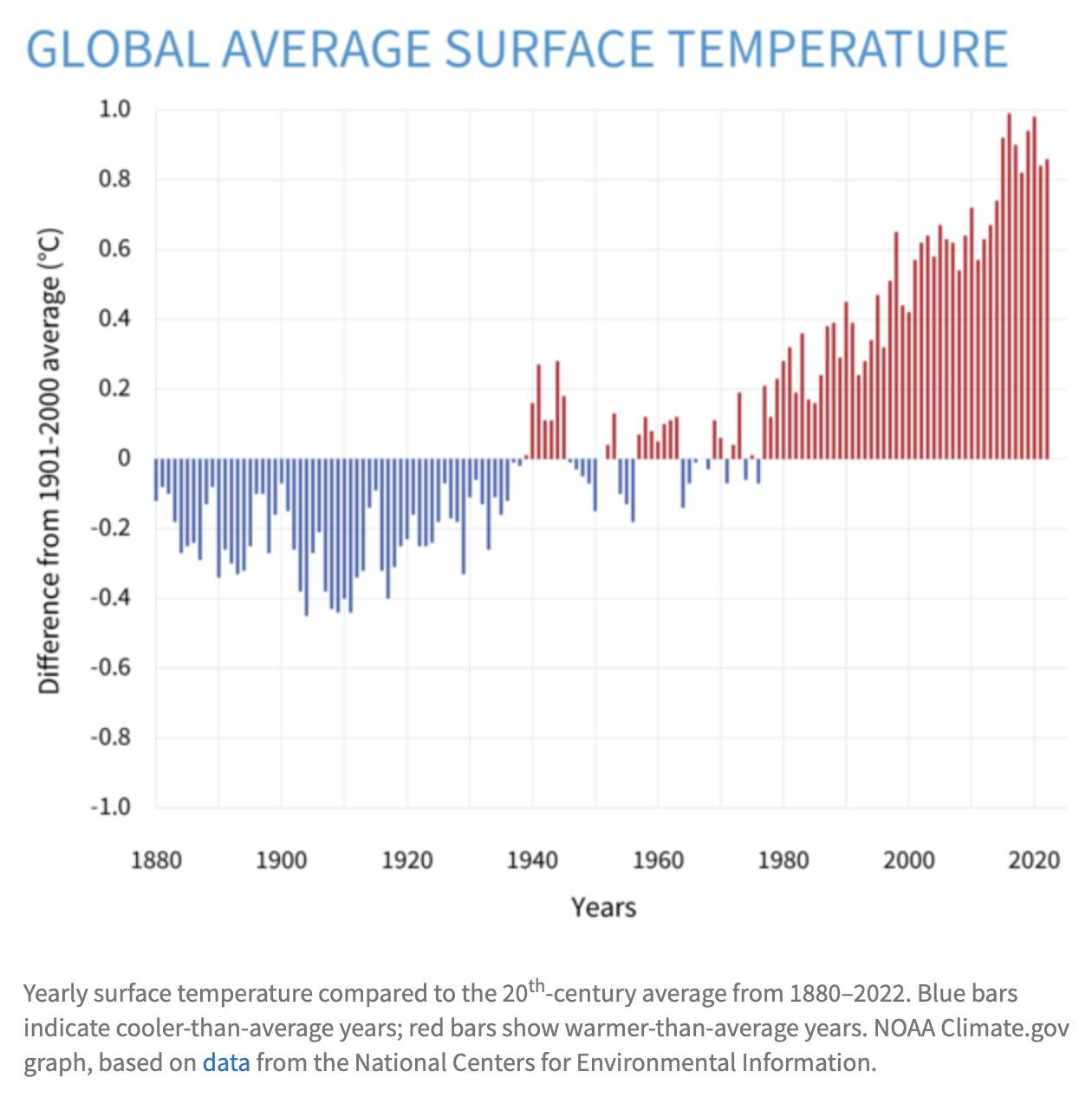
I have looked at many charts and they mostly look like this:

Global avg temp going up and to the right. Now some people will say these are just random fluctuations that have happened over the millennia. That’s where we need scientists to study the trend to see if there is any secular warming trend vs just cyclical, natural fluctuations and what are the causes.

People also claim climate science is fake and climate models are grossly inaccurate. Well, are they?
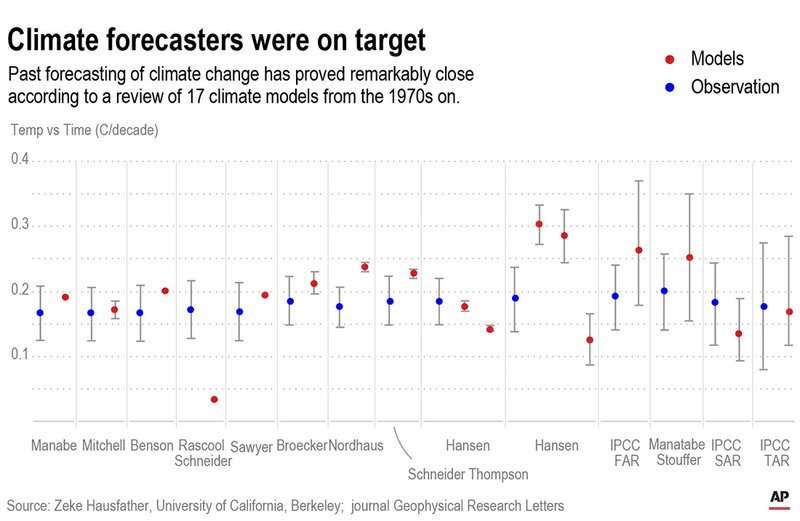
After years of hearing critics blast the models’ accuracy, climate scientist Zeke Hausfather decided to see just how good they have been. He tracked down 17 models used between 1970 and 2007 and found that the majority of them predicted results that were “indistinguishable from what actually occurred.”

“By and large our models have gotten it right, plus or minus a little bit,” said Hausfather, a UC Berkeley scientist who is climate and energy director at the Breakthrough Institute. “If they get it wrong, it’s slightly on the warm side, but I wouldn’t read too much into that.”

Ten of the 17 were close to the temperatures that actually happened, said Hausfather, lead author of a study in Wednesday’s journal Geophysical Research Letters.

But scientists actually got the physics right even more than that, Hausfather said.

Climate models are based on two main assumptions. One is the physics of the atmosphere and how it reacts to heat-trapping gases. The other is the amount of greenhouse gases put into the air.

A few times, scientists were wrong in their predictions about the growth of carbon pollution, saying there would be more of the gases than there actually were, Hausfather said. If they got the amount of heat-trapping gases wrong, they then got the temperatures wrong.

So Hausfather and colleagues, including NASA climate scientist Gavin Schmidt, looked at how well the models did on just the pure science, taking out the emissions factor. On that count, 14 of the 17 computer models accurately predicted the future.

Models are continuously being improved. Older models are less accurate than newer ones. We understand the science better over time. Our computing power has also grown leaps and bounds which would help model accuracy.

It looks to me climate science is just like any normal science field. Researchers and their PhD students all race to put out more accurate models. There is an objective test at the end: does your model match observed data? I don’t see how all this can just be fake science.

Are we supposed to believe that only 17 models were published from 1970 to 1999? I think the graph Acre shared showed there are TONS of published models. It’s also interest that cuts off in 2007. It’s since then that the models have become so inaccurate. I think I’d trust the data with 90 models not 17 that actually goes to recent years.

1 Like

Nope. There are more than 17 models. I have addressed this critique before. We are supposed to learn from what the inaccurate models get wrong, coalesce around and improve the good models.

I think you have a misconception about science. Getting things wrong is part of science. All models are wrong, just to various degrees. Science is a dynamic process. We are supposed to learn and improve.

What you have in mind is more of what a religion is like. Things are frozen in time. If something didn’t happen according to a model made in 1970 that means the whole field is bunk.

More weight should be placed on recent models. They are performing pretty well.

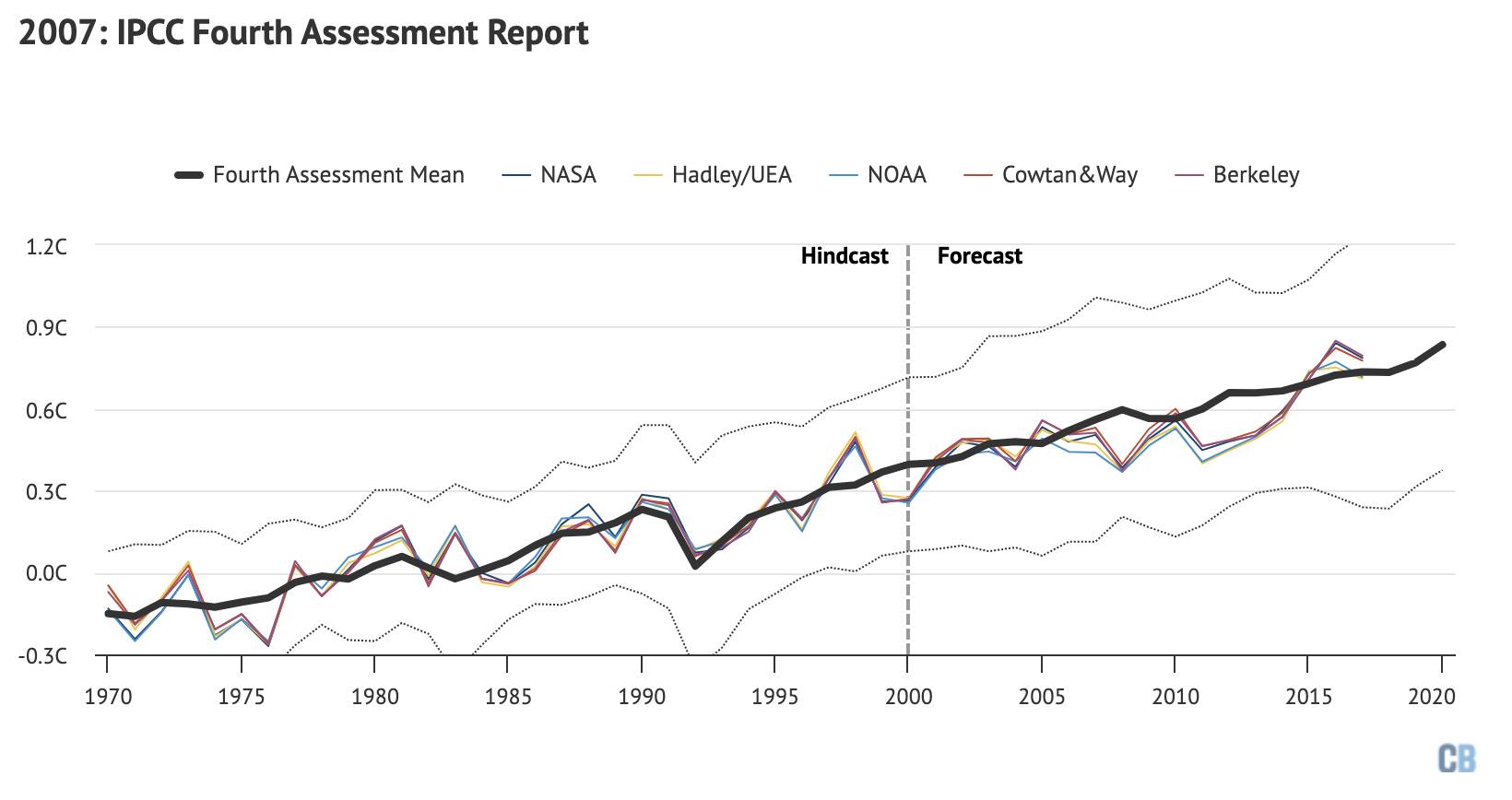
IPCC Fourth Assessment Report, 2007

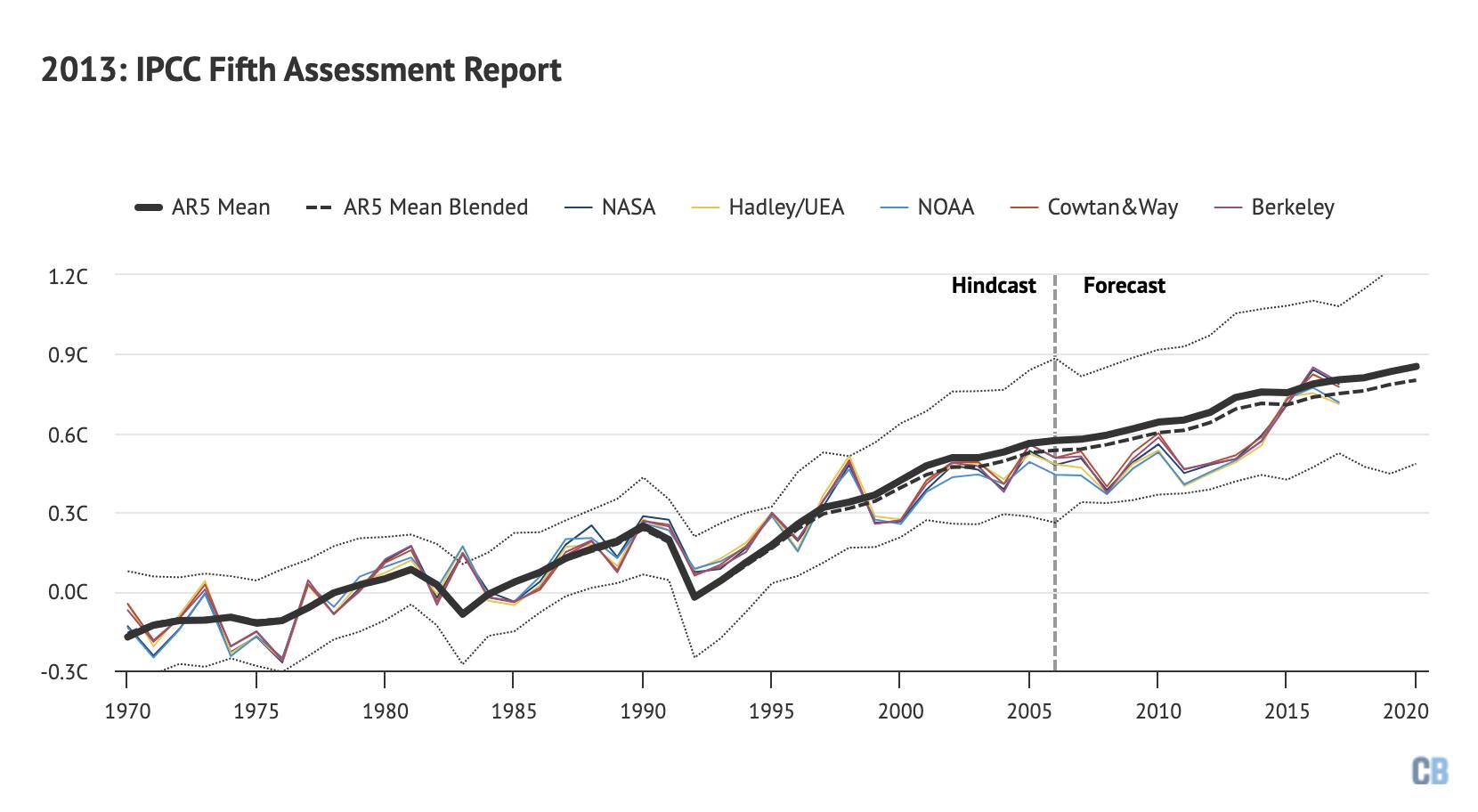
IPCC Fifth Assessment Report, 2013

The news media loves bad news… even if didn’t happen…
Idilia didn’t live up to the hype… of course that isn’t being reported just like the underwhelming storm in SoCal…
in reality we just had the coldest winter spring and summer in my memory in Tahoe and my farm. My harvest has been delayed a month and it’s raining now…. Global warming?
Personally I think weather like politics is a local issue.
Global warming sounds pretty good to people living north of the 50th parallel. Oceans rising…. Not much evidence.

Meanwhile Florida residents know how to deal with flooding

Haven’t we taken tons of coal power capacity offline though? The whole reason we need renewables is we shutdown other electricity generation. Ok. I had to see if my hypothesis was correct.

The amount from renewables is much less than what we’ve taken offline just from coal.