Even though we have leverage, there was a scientific theory behind it…
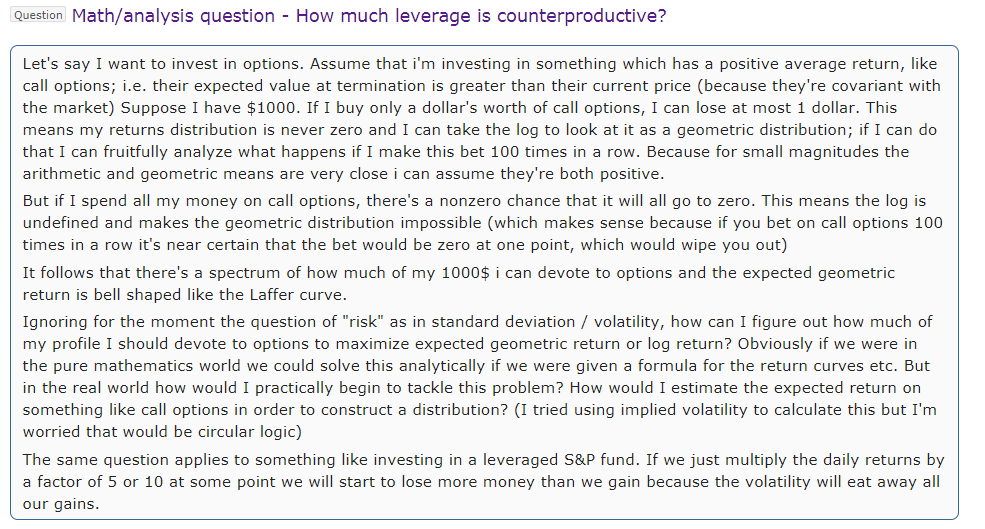
You said that insurance companies using call options was bad.
The end.
Hmm, stock options are way more complex than a coin clip, since you have far more outcomes. The number of possible outcomes makes it very difficult to determine your payout for winning. You could win and get a 10% payout. You could win and get a 300% payout. You don’t know how much you win by.
I think to apply the formula to call options, you’d have to consider what % of years does the stock market end the year higher. Then in those years what is the average percent again. Then evaluate what your call option would be worth if the market achieved the average percent gain in an up year.
The $205 Jan, 2019 SPY call is where time premium is zero ($60 cost). That means if the stock market is higher, then it wins. The market ends the year up 70% of the time. Anyone know the average gain on up years? I think it’s ~12%. If the market ends the year 12% higher, then the return on the call is 53% of initial investment.
(0.7 * (0.53 + 1) - 1) / 0.53
13.4%
You could go closer to current price on the call, but then the market needs to go up by a certain percent before you’re a winner. If you go the $265 call, then you need a 6% gain before you’re a winner. That’s going to happen in a lower percentage of years. The gain in those years would be bigger. Assuming it’s over 6% 30% of the time the average gain is 18% in those years then:
(0.3 * (3.04 + 1) - 1 / 3.04
7.0%
It seems favorable to do a deep in the money call which has a higher percent of winning even though you win less. The higher payout of scenario 2 isn’t enough to offset the higher risk of losing. I didn’t see how to account for losing means you don’t lose the whole value of the bet. Since the deep in the money call has a wide range of “loss” before you’d lose 100% of the bet.
This is interesting, because I’ve done much better with deep in the money options than options near the current price.
1 Like