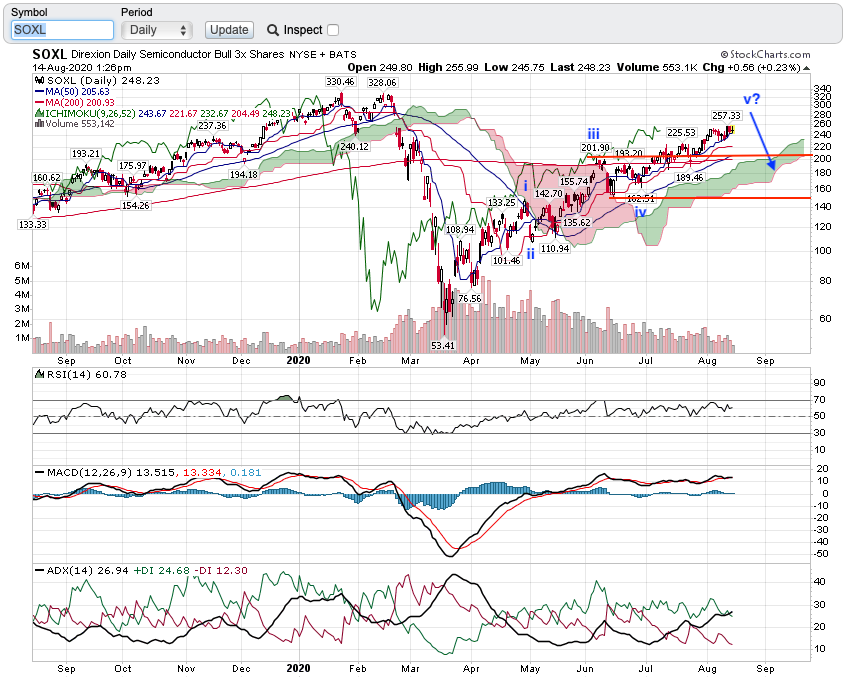
Since your system doesn’t work for SOXL, the possible EW count is:
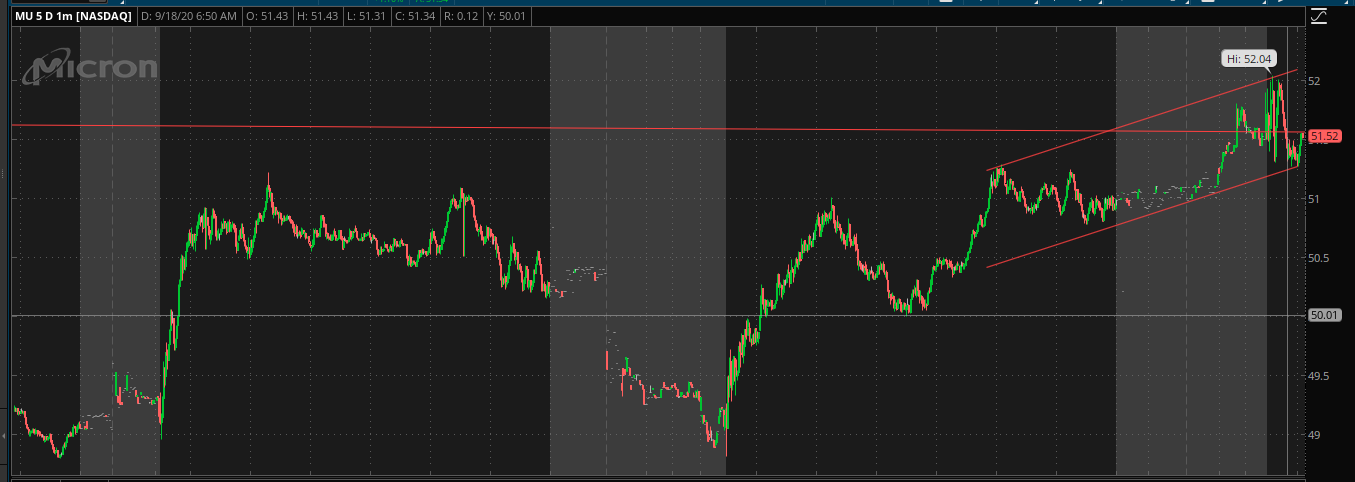
wave v is completing soon - haven’t figure out the rough range of targets yet. Retracement of the impulse is to $150-$200. Truth be told, haven’t use EWT to trade, merely trading the channels. Seem good enough for multi-day trading (open/close within 5 days i.e. usually close position before weekend).
.
One trick here is very important: Make sure you never make even Single $ loss. You do not need to gain (cash position), but you must always gain (when you are in) and absolutely zero loss.
Do whatever analysis possible for you to make zero loss.
If you practice for a while in trading, they are the master of trading.
If Intel were to outsource manufacturing to TSM, Taiwan would be the most geopolitically important country in history.
He made a similar argument as mine, except I think it is no longer an “if”. Intel forever losing the Moore’s Law race is the most important geopolitical event happening in 2020 that nobody talks about.
It is as if Taiwan becomes the entire Middle East and the West would have to militarily intervene if China invaded. Expect Taiwan to become more diplomatically and strategically integrated with the West in the coming years.
Wrong choice of word. Taking back what is your is not invade. Anyhoo, China won’t use force vs Taiwan just like China didn’t use force vs HK. Don’t believe talk about police, people always think police is bad, as bad as criminals? IMHO, is a coping mechanism to the fear of authority.
I just feel the author creates a negative hype on INTC specifically. Read his words.
I have been following semiconductors for 20 years and had never been bullish on Intel until June, 2020 when I bought the stock and made it a significant position for the first time in my career.
If any one following Semi’s for 20 years and not bullish on Intel - This is complete hypocrisy.
Author chooses specific time frame just before the INTC drop, creating negative hypes on Intel - naturally whoever holds Intel Pre-fall period hates and sell it.
After this INTC fall, it is attractively priced, but future few quarters may be issues and then recover.
For my investment point of view, when I see S&P falls to down bottom (like mar end), I would prefer to buy both TSM and INTC - as they both look attractive at that time.
Second, when S&P falls, INTC will fall way faster than TSM. This will give us a chance to get it at lowest price and get ever lasting dividends.
This another waste of money on zombie firm. who is giving $40b to Nvida except for stock boost.
ARM stagnating revenue.
I doubt much of London employees want to move.(how many will be Euro engineers that will move to Euro projects)
I finally understand why TSM shot up today. Apple’s A14 is fabbed on 5nm process. Nobody expects 5nm is already in volume production, vastly ahead of schedule.
Jensen Huang, the new king of the hill in the semiconductor world, has just taken what looks like an uncharacteristic risk.
His company Nvidia’s agreement on Monday to pay up to $40bn for chip designer Arm Holdings has threatened to provoke a backlash from Arm customers who see the US-based firm as a rival.
“We’re not going to stand on anyone’s toes,” Mr Huang insists — although that may not be the way the rest of the chip industry sees it. Critics also say he has risked making his company a pawn in the tech war between the US and China, whose antitrust regulators two years ago failed to clear a $44bn acquisition being pursued by another US chip company, Qualcomm.
That Mr Huang has ploughed ahead is a sign of just how much is at stake. Having brought Nvidia to the top of the chip industry through an unconventional route, he believes the deal could now help it become the dominant chip company of the artificial intelligence age.
Mr Huang has already taken big steps towards that goal. The maker of graphics chips that he co-founded 27 years ago has seen a spectacular 10-fold leap in its share price over the past four years, as its chips have become the main engines for training the neural networks that lie at the heart of much of today’s artificial intelligence. The rally pushed Nvidia past Intel in July to make it the world’s most valuable chip company, and left Mr Huang with a personal stake worth $11.6bn.
It took a powerful idea, a strong technical background, and a firm grounding in the realities of the industry to carry him to this point.
“His vision is out five to 10 years — he isn’t talking about going to Mars or something,” says Tench Coxe, a venture capitalist who has been a director of Nvidia since backing the company when it was formed in 1993.
At a casual glance, there looks to be a strong streak of flamboyance to the Nvidia chief. There is his penchant for leather jackets and all-black attire, which he adopted more than a decade ago, at a time when much of Silicon Valley was emulating Apple’s Steve Jobs. There is the tattoo, based on Nvidia’s logo, at the top of one arm. And there is the love of flashy cars: he owns two Ferraris and a Koenigsegg, along with a penchant for Mercedes.
But it would be a mistake to jump to conclusions about Mr Huang’s personality from this. He has admitted that he “was crying like a baby” at the pain from the tattoo, which he got when Nvidia’s share price first passed $100. One colleague says he likes the cars because they are “cool”, not because he drives them fast, and another says his day-to-day ride is a white Tesla Model S.
In short, Mr Huang has all the hallmarks of the hardworking Silicon Valley technocrat. His days start at 4am. He is said to enjoy an early morning exercise session before moving on to a 14-hour day. Family is all: he met his wife, Lori, on a lab assignment the two shared in their first year as undergraduates. They have a son and a daughter.
His arrival in the US from Taiwan at the age of nine was far from conventional. His family scraped the money together to afford schooling for him and an older brother at what he calls “the most affordable boarding school in America” — a Baptist school in rural Kentucky that had some of the hallmarks of a reform school. Cleaning the bathrooms daily for a dorm of 150 boys was part of the deal, he says. But he also says he “loved every minute” of it, and calls it a formative experience.
Mr Huang took degrees in electrical engineering at Oregon State and Stanford universities and worked as a chip designer, before quitting to start Nvidia at the age of 30 with two friends. He still takes a close interest in vetting Nvidia’s technical decisions. That means he has a clear understanding of “where the puck is going” in the chip world, says Rene Haas, who worked at Nvidia for seven years before becoming a top Arm executive.
Mr Huang himself credits a singular insight for putting him on a track to the top. He says he sought out a technical challenge that was difficult enough to require an intense research and development effort — something that would carry the company to further breakthroughs in future.