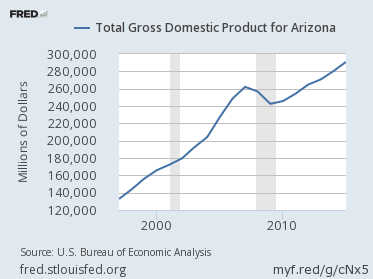
Many of them used to work part-time though. Now a lot less of them do. Participation rate is those working. There’s also those working part-time that want full-time work and can’t find it.
https://www.bls.gov/cps/cpsaat20.htm
Moody and WSJ were trying to isolate the effect of immigration change. It does not mean Arizona GDP went down 17% during that time. Obviously there were many other things going on, with the massive QE programs being the obvious ones. But that -2% a year, they concluded, was the negative effect of the change in immigration law.
1 Like
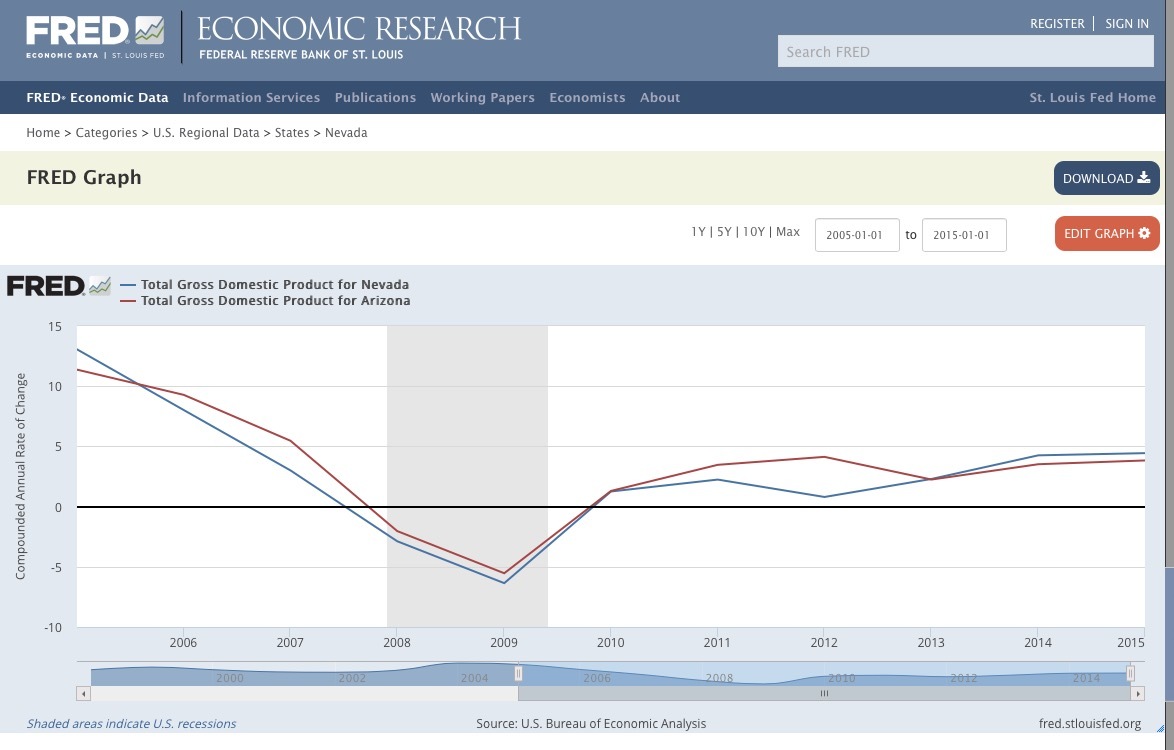
Graph of “Compounded Annual rate of Change” of 2 neighboring similar sized states -
Arizona(which had the strong immigration laws) vs Nevada(No strong immigration laws).
Point is both the states behave similarly in GDP trend, hence immigration drop is not necessarily the reason for Arizona’s drop in GDP growth.
1 Like
How about you reset the starting time to 2008?
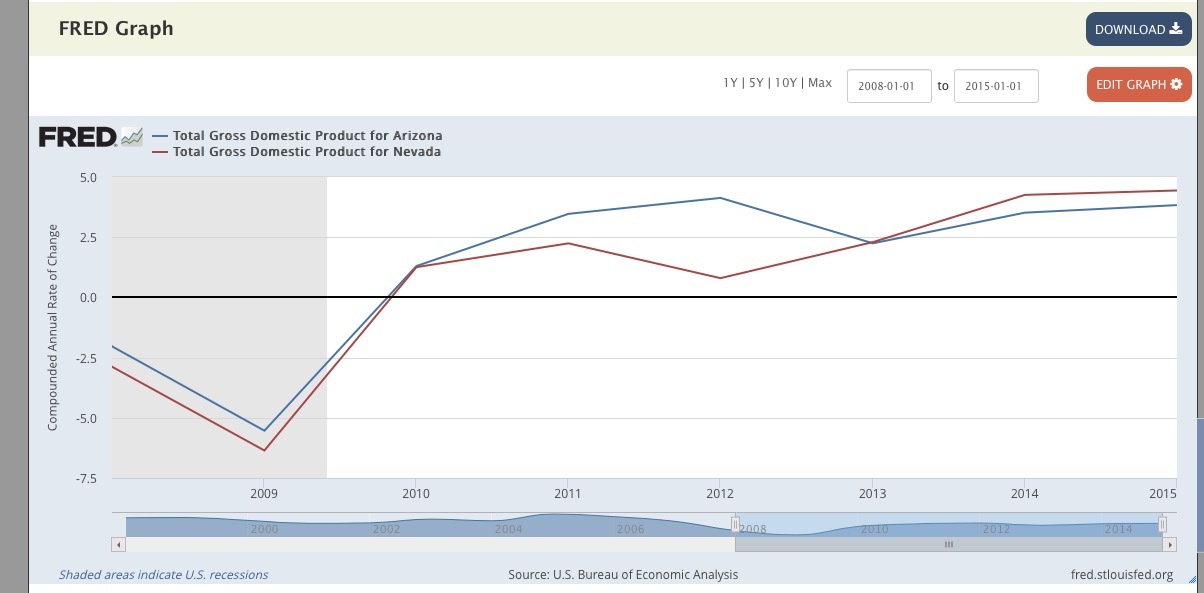
Difficult to tease out the average compound rates. Can you do the math and let us know? 

Seems massive deportation is starting today. We will know the result soon enough…
The fact is that this country is getting old, not enough young people contributing to SS.
It’s hard for a 40+ years old person to go to work on the fields. Also painting, roofing and any construction trade.
You need young immigration, hard ass working people besides the ones sitting on a desk. Somebody needs to plow the earth, sow and harvest the crops. The end!
I’m resigning to the fact that there would be hyperinflation. Guess I need to experience it once in a lifetime 
Look like Trump doesn’t believe in economists and econometric models… do first and adjust accordingly rather than consider thoroughly before implementing. Roller coaster rides for all of us.
1 Like
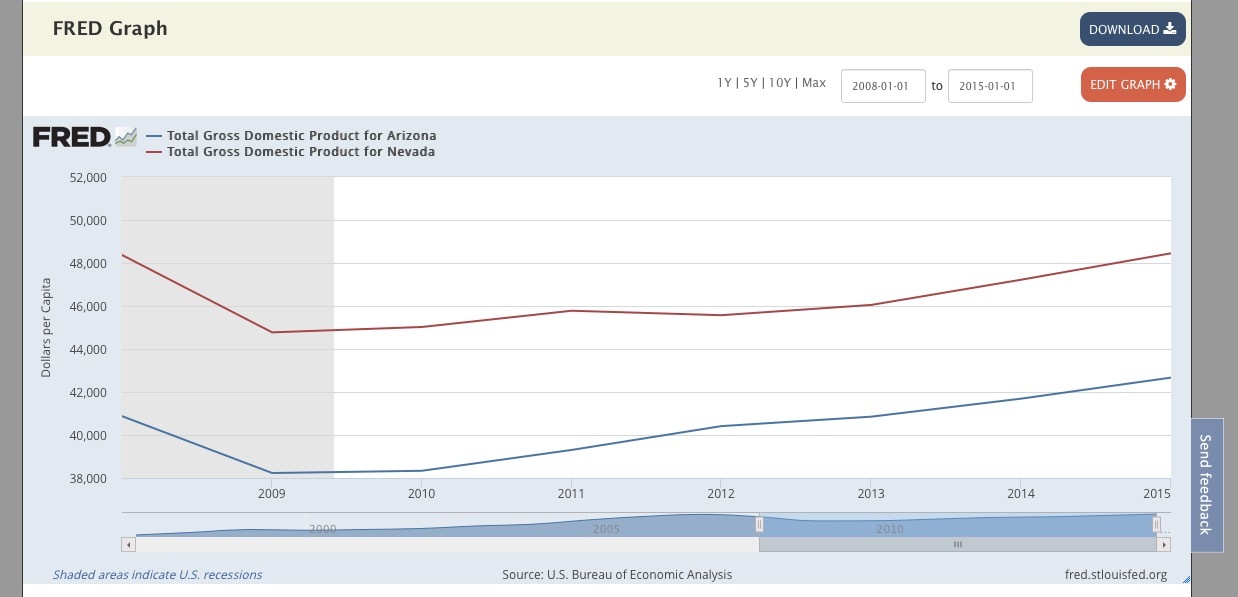
The whole point is that GDP doesn’t equate with quality of life. GDP can go down because a bunch of people leave an area but the remaining people can get richer at the same time. They can also experience less crime and fewer other social costs e.g. ESL services in schools. Talk to some people in AZ; there is broad support for their immigration policies even among Hispanic citizens. And, as I pointed out above, unemployment in AZ is lower than in CA almost 10 years after this “experiment” was conducted.
1 Like
The flip side may be that farm automation companies will see a sales boom.
GDP in total, not per person, correlates to companies’ earning and thus its stock price. Another thing to keep in mind if GDP falls, or not grow as fast, because of tighter immigration.
I support any immigration-deportation policies that are humane. Even among Hispanic people aka Mexicans, we/they don’t want criminals, they got to go.
What we advocate is the fair implementation of the laws. For example, tell me when have you heard the ICE raiding any store-restaurant-whatever business in Chinatown, Japantown, Russiatown, any high tech place? Illegals are all over, and they don’t look like Mexicans. They may be working at Google. Who knows!
As far as I know, ranchers, farmers, people dealing with cattle, grains, produce, fruits, are shaking their heads in disbelief, knowing that this border tax and deportations will hit their pockets big time. Even putting them out of business.
Really hyperinflation in USA?
Following are few examples of hyperinflation:
Austria
Start and End Date: Oct. 1921 – Sep. 1922
Peak Month and Rate of Inflation: Aug. 1922, 129%
China
(1) Start and End Date: Jul. 1943 – Aug. 1945
(1) Peak Month and Rate of Inflation: Jun. 1945, 302%
(2) Start and End Date: Oct. 1947 – Mid. May 1949
(2) Peak Month and Rate of Inflation: Apr. 5,070%
Germany (Weimar Republic)
(1) Start and End Date: Jan. 1920 – Jan. 1920
(1) Peak Month and Rate of Inflation: Jan. 1920, 56.9%
(2) Start and End Date: Aug. 1922 – Dec. 1923
(2) Peak Month and Rate of Inflation: Nov. 1923, 29,525%
Zimbabwe
5 May: banknotes or “bearer cheques” for the value of ZWN 100 million and ZWN 250 million.[53]
15 May: new bearer cheques with a value of ZWN 500 million (then equivalent to about USD 2.50).[54]
20 May: a new series of notes (“agro cheques”) in denominations of $5 billion, $25 billion and $50 billion.
21 July: “agro cheque” for $100 billion.
More examples in the link below:
It’s interesting to note from the WSJ article about changes in AZ’s employment as undocumented workforce was cut back (40% from '07-'12)-- how employers in agriculture and construction dealt with worker shortages differently. It seems that farmers were looking to investing in mechanization and operators to replace workers (sometimes needing to drastically reduce output as well). In construction, it resulted in scarcity and increased wages (up to 50%) for construction workers. As Mexico’s economy improves and benefits from keeping its workers ‘at home’ it is possible that there will be less need to products from the US (our #2 export customer), concerning to those in the ag / livestock business.
According to the Moody’s analysis, low-skilled U.S. natives and legal Hispanic immigrants since 2008 picked up less than 10% of the jobs once held by undocumented immigrants. In 3 a separate analysis, economists Sarah Bohn and Magnus Lofstrom of the Public Policy Institute of California and Steven Raphael of the University of California at Berkeley conclude that employment declined for low-skilled white native workers in Arizona during 2008 and 2009, the height of the out-migration. One bright spot: the median income of low-skilled whites who did manage to get jobs rose about 6% during that period, the economists estimate.
As the Arizona economy recovered, a worker shortage began surfacing in industries relying on immigrants, documented or not. Wages rose about 15% for Arizona farmworkers and about 10% for construction between 2010 and 2014, according to the Bureau of Labor Statistics. Some employers say their need for workers has increased since then, leading them to boost wages more rapidly and crimping their ability to expand.
1 Like
I think agriculture is easier to automate than construction. Construction is already fairly mechanized, and wages are pretty decent. Also putting up dry walls takes more skill than picking fruit I think.
Here is another good article from Economist:
1 Like
I have seen ads for agricultural workers paying $0.14 for trimming a grape tree. It takes some skills to do that job, and a very exhausting if you ask me. Cutting the cluster of grapes? Another skill.
I’ve seen mechanized sowing, where a tractor has a replenishing group of people feeding it with plants, but still, somebody has to be hanging at the front sticking the plants in holes.
We may be not far away from being completely mechanized, but still, people are needed to drive and operate machines. And lifting, packing and whatnot.
Also, workers are needed in different locations, which makes anybody wanting those jobs a nomad type, 6 months here, 6 months over there. Not suitable for your typical “I want to have a good job, get married and a house with white pickets…”
I seriously doubt Google hires illegals to do anything, As for those restaurants I’m all for enforcing immigration law there - although I have no reason to believe ICE doesn’t raid them. My attitude is the same as when I hear that more black murderers get the death penalty than white murderers. My assumption isn’t that blacks are getting a raw deal; it’s that the system is being too easy on whites.
Is there ANY nation that doesn’t have borders - and doesn’t have laws regarding who comes and goes? There are groups of nations like the EU who have agreed on free movement of MEMBER workers but no one who just says “show up and it’s all good one way or another.”
1 Like
I also doubt that American builders, construction sites and janitorial companies, painting contractors with deals with Facebook, Google or Microsoft, don’t use illegal labor but let me tell you, I know they do.