Are you gonna update this everyday? lol
1 Like
There will be a lot of volatility during earnings season. Hopefully we start to get some differentiation instead of the whole group trading together.
1 Like
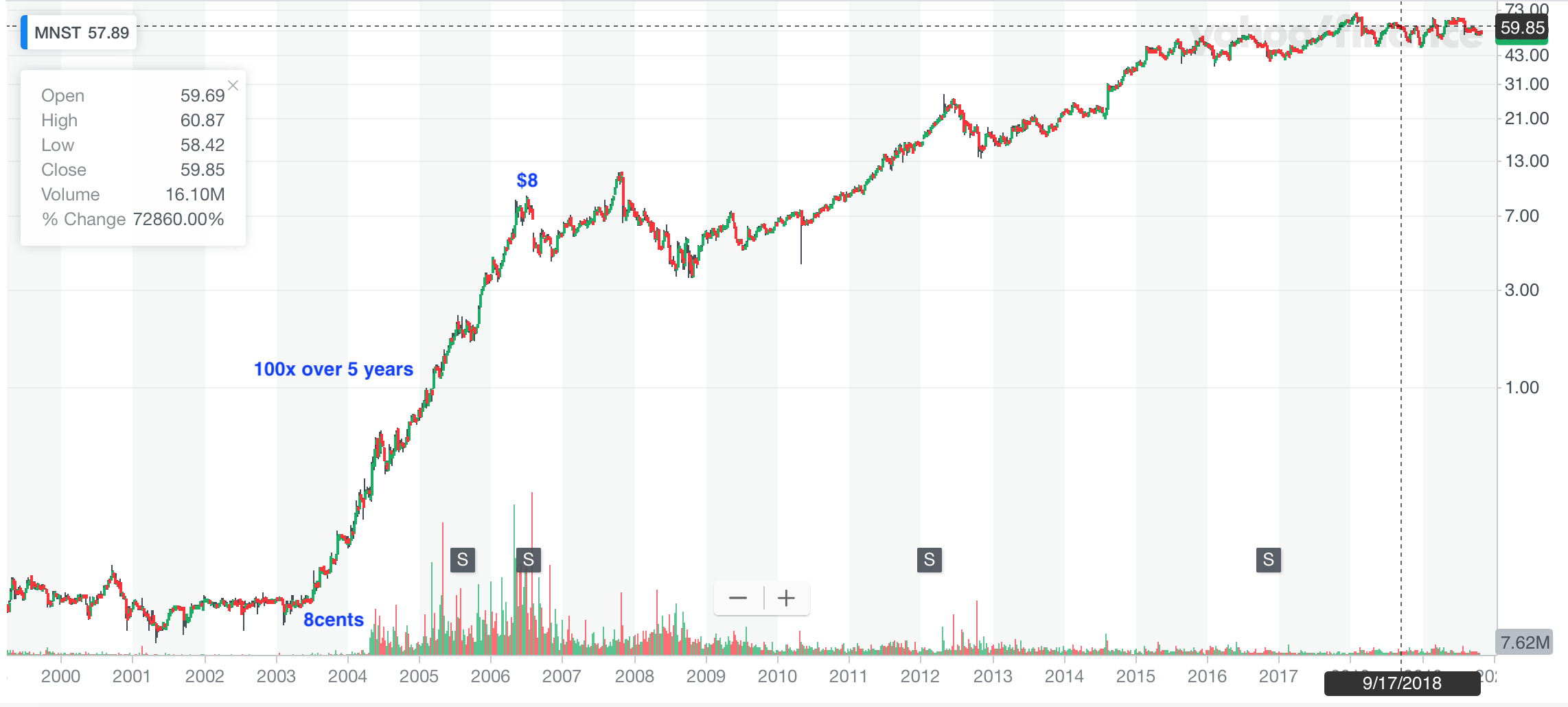
30% over 2 years? Sell! We need min 26% per year. Ideally, we want stocks like AAPL between 2003-2008, 30x ! Alternatively go for long calls,
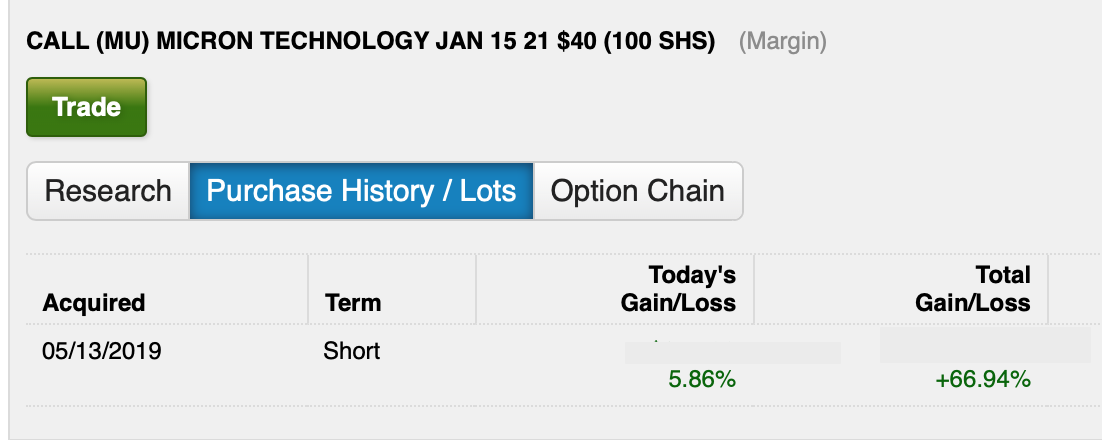
His top pick among the semis is Micron.
Meeks estimates the stock price could soar another 50% to 60% within two years because valuations are so low.
Read the article. Agree that MU is the best semi to long.
1 Like
I do not know how many people follow this stock,BYND - turned into profit now, but it is beaten down even today after market and after good results.
Lock period expiry tomorrow(today end of day).
This is not a recommendation to buy or sell. Stocks are risky and not suitable for everybody. Please do your own research.
This is not a recommendation to buy or sell. Stocks are risky and not suitable for everybody. Please do your own research.
Cut & Paste from WSJ
By Jacob Bunge/WSJ
Updated Oct. 28, 2019 6:09 pm ET
Beyond Meat Inc. is doubling down on marketing the nutritional value and environmentally friendly production of its meat alternatives in the face of growing competition to sell plant-based burgers, including from some of the biggest food companies.
Beyond and Impossible Foods Inc. have revolutionized the veggie burger business, replacing mushroom and bean patties of the past with new versions built from pea and soy proteins, which more closely mimic beef’s juiciness and sizzle. The new products have made the meatless niche one of the hottest-growing corners of the food business: Meat alternative sales grew 9.2% over the 52 weeks ended Aug. 24 to $925 million, according to Nielsen, while traditional meat sales grew 1.9% to about $95 billion.
That expansion helped make Beyond one of the year’s most successful initial public offerings. Beyond on Monday reported its first quarterly profit, net income of $4.1 million, or 6 cents a share, for the three months ended Sept. 28. Sales more than tripled to $92 million for the period.
California-based Beyond is developing new promotions and products aimed at extending its rapid growth over the past year in restaurants and grocery stores. That expansion has helped draw competing imitation meats from companies including Tyson Foods Inc., Smithfield Foods, Nestlé SA and Kellogg Inc.
Beyond’s Chief Executive Ethan Brown said he isn’t threatened by the fresh competition from established food companies.
“History’s replete with examples of companies that have tried to unseat the disrupter and have been unable to do so,” he said in an interview.
Mr. Brown said Beyond will continue to market its plant-based proteins as better than traditional meat for both consumers’ health and the environment. He said Beyond is developing celebrity-centric promotions to help spread the word.
Since going public in May, Beyond Meat has signed up some of the world’s biggest restaurant chains to serve its yellow-pea and coconut-oil-based patties. Dunkin’ Brands Group Inc. this month confirmed it would sell Beyond breakfast sandwiches nationwide. In late September McDonald’s Corp. began testing a Beyond patty in Canada. Denny’s Corp. on Monday said it would introduce Beyond burgers in Los Angeles.
Not every launch has been a success. In September, Restaurant Brands International Inc. ’s Canadian chain Tim Hortons said it didn’t plan to continue selling Beyond burgers after a limited-time offer ended, and the offering didn’t boost sales for the brand in third-quarter earnings reported Monday. It is still selling breakfast patties with Beyond’s imitation sausage but has scaled back the number of restaurants.
Mr. Brown said Beyond hasn’t lowered its prices in response to rising competition. The company wants eventually to match or beat the price of at least one traditional meat product. Cattle ranchers and hog farmers are pushing back by questioning the plant-based burgers’ nutritional value and encouraging regulators to defend their turf. Congressmen from Kansas and New York on Monday introduced a bill that would establish a federal definition of beef, require the FDA to “clarify the imitation nature” of meat alternatives, and give the U.S. Department of Agriculture more power to police misbranding.
Michele Simon, executive director of the Plant Based Foods Association, said more meatless options are good for the sector, helping propel the products into the eating mainstream.
Beyond’s stock rocketed higher after the company’s May 1 initial public offering at $25 a share, peaking at $239.71 in late July. Shares fell after some investors sold stock in early August, alongside a secondary offering and rising competition. In the last three months, Beyond shares have lost more than half their value, closing Monday at $105.41. The company remains one of the most heavily shorted among public debuts this year.
On Tuesday, a restriction on insider stock sales will lift, freeing up about 49 million Beyond shares to be traded, about 77% of shares outstanding. Mr. Brown said he doesn’t plan to sell any of his own shares and hasn’t asked Beyond employees to hold off on selling. The end of the lockup sent shares down 8% in after-hours trading.
Some analysts see the growing competition as Beyond’s biggest challenge. In North Palm Beach, Fla., executives for gourmet hamburger chain BurgerFi have been inundated with pitches from makers of plant-based patties, said Steve Lieber, the chain’s head of business development.
For now, BurgerFi is sticking with Beyond burgers, which Mr. Lieber said generate about 5% of the chain’s sales. But, he said, “The competition is going to be great because hopefully we’ll wind up getting better products.”
—Heather Haddon contributed to this article.
1 Like


Btfd
Nowadays bomb during AH recover during market hrs. Not good for option traders  may have to adopt @manch margin approach
1 Like
Twilio earnings for the third quarter fell from a year earlier as company guidance fell short of Wall Street targets. Twilio stock plunged in extended trading on Wednesday on weak December quarter outlook.
When FA is not good, TA will not come into picture.
Buy the DIP is best when FA is good and stock drops.
That was what happened with AMZN and BYND, FA was good, but stock dropped (traders fear - who did not study/research properly - after results)
? TA always reflect FA.
Not really.
The TA is purely short term,within 30-60 days, while FA is long term…years.
Take the example of Apple. as per TA, this is very high esp on RSI…other TA. When FA exceeds, TA fails.
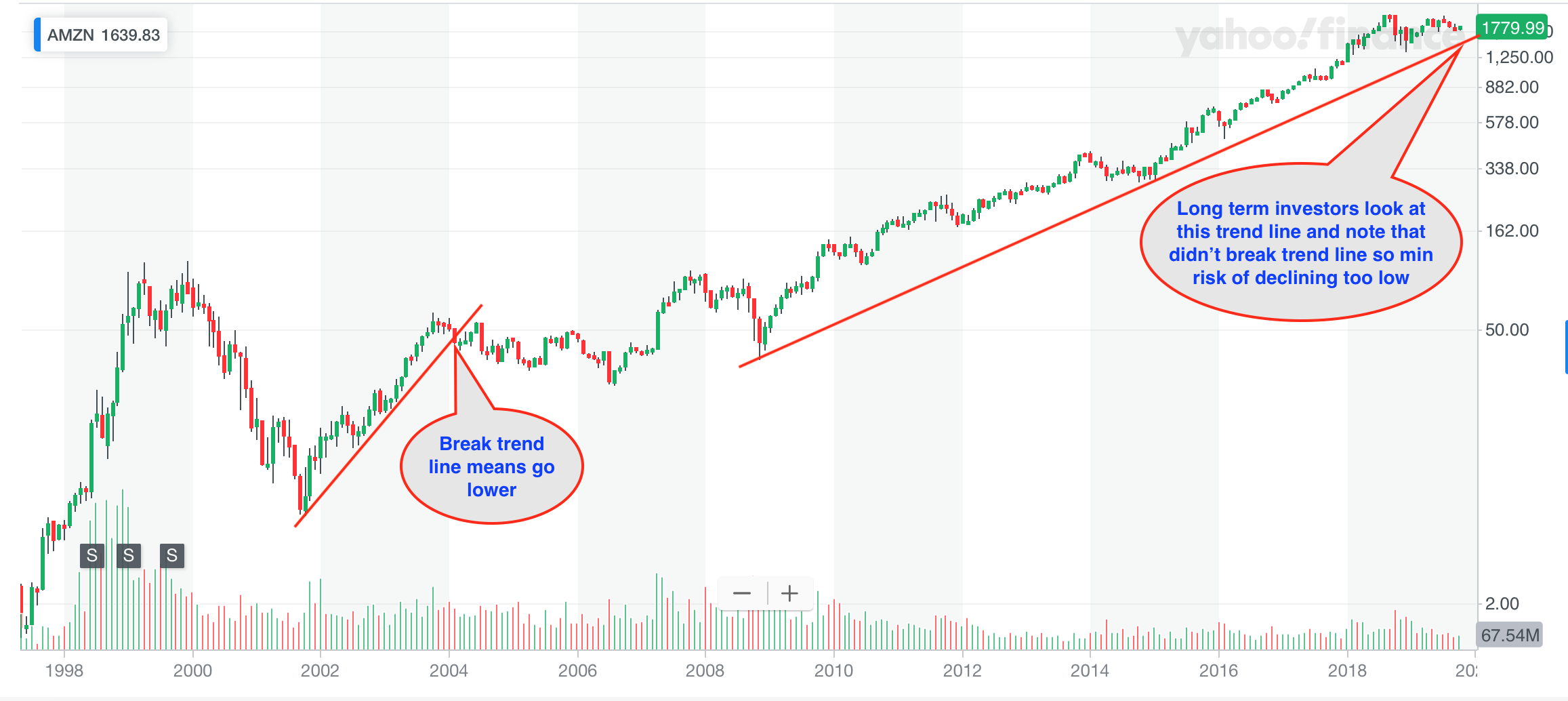
TA is also long term! You need to learn more about TA  For example, simple trend lines, notice I draw very long term to very short term
TA rarely works for long term, very rare case, TA for long term will not work unless FA changed meanwhile.
Take your chart of SHOP…show the long term TA points. the long term points ($250 down side) did not hit, while short term ($290) hit (or near hit).
Allow me to jog your memory. Refer to chart below. Span a few decades. Intended for buy n hold investors not swing traders.
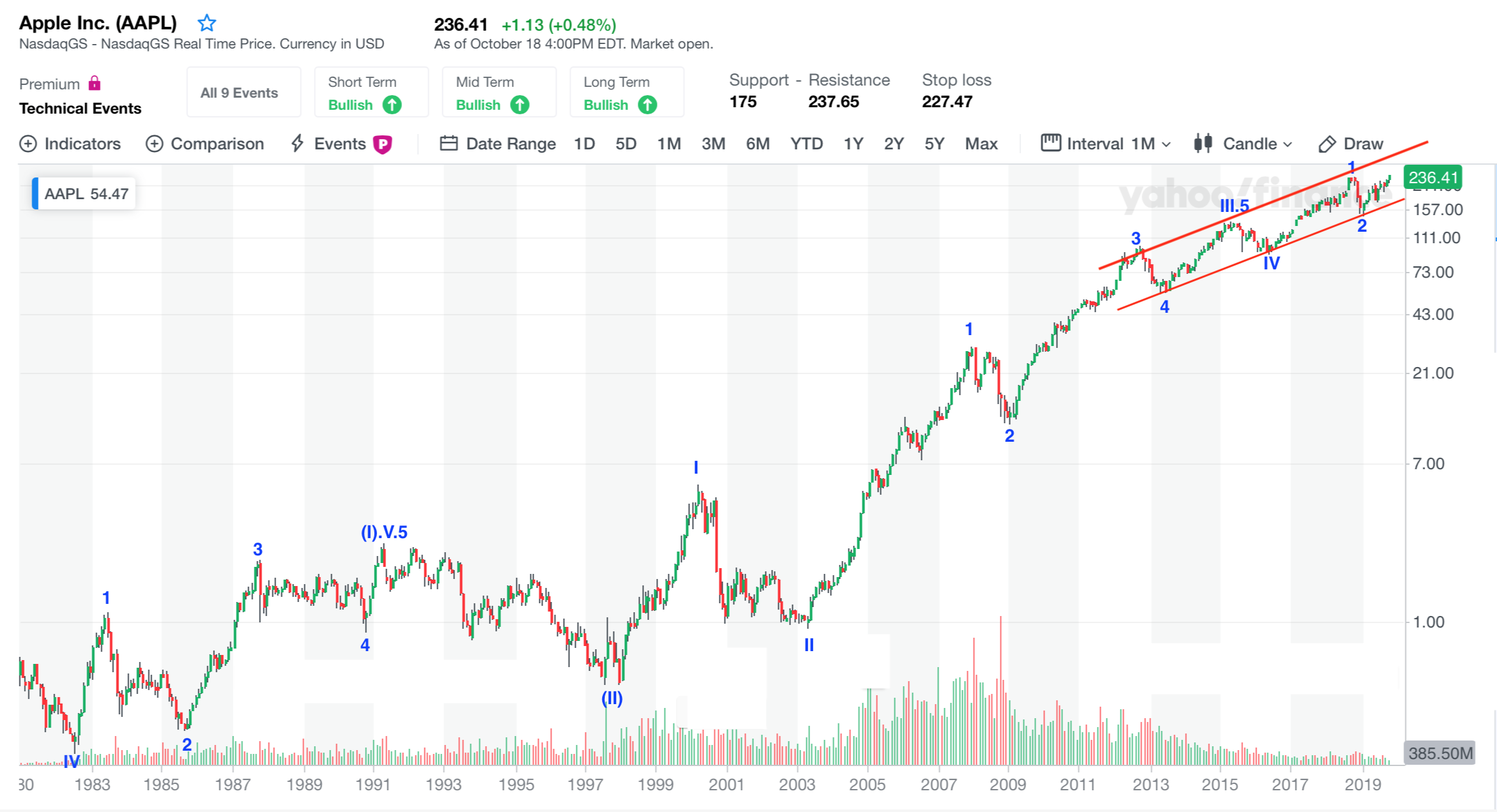
@jil I think you are mixing long term and short term. Are you expecting long term price point to be achieved in hrs or days? And mixing possibilities with certainty?
2 Likes
Hindsight is 20//20. Are you saying Apple will repeat its past performance in the next 10 years?
no. Just illustrating TA is for very short term to very long term. Just have to use the right charts.
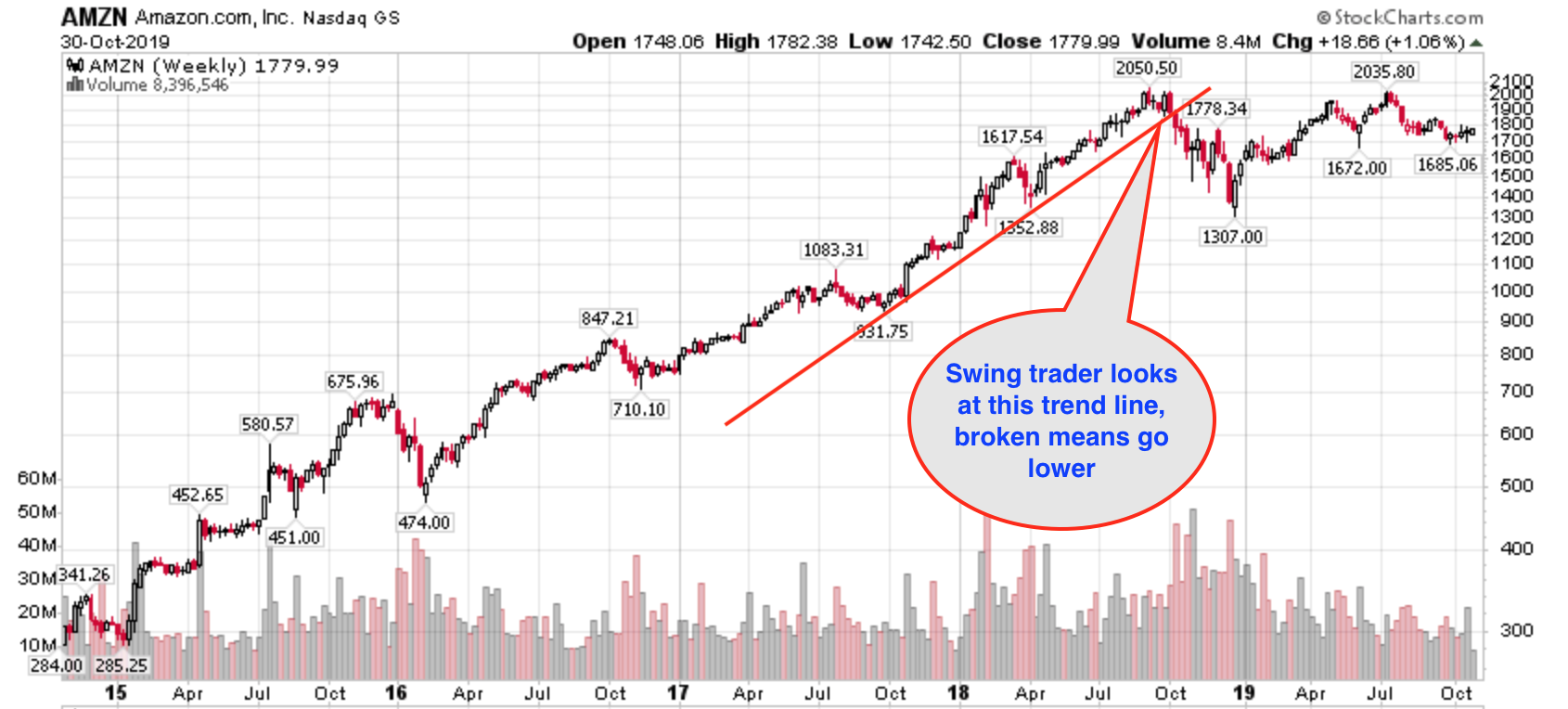
Since you like AMZN, below are charts for AMZN investors and swing traders. As you can see, swing traders would have sold AMZN in Oct 2018 while investors would do nothing.
1 Like
I am not mixing both. I see your AAPL Elliot wave, but I am not so much expert on EW, yet reading the book now. Any way, it is beyond my level.
[quote=“hanera, post:2921, topic:2789”]
As you can see, swing traders would have sold AMZN in Oct 2018 while investors would do nothing.[/quote]
Correct, but swing trading gives the benefit to buy at dip. If you remember that I told bulk purchase done on 12/26/2018. I got AMZN at 1376.14, but sold around $1900, waited for next opportunity, bought at $1650. The spread between $1650 and $1900 is the benefit of swing trade.
1 Like
“But for the current quarter ending Dec. 31, Twilio forecast revenue in a range of $311 million to $314 million vs. estimates of $322 million. The company said it expects profit of 1 cent to 2 cents vs. estimates of 7 cents.”
The reason for TWLO drop. It closed after hours back above $99, buying at $90 would have been an easy 10% profit in less than 2 hours. It’s crazy how stocks are bouncing back well off the after hours lows.
2 Likes