The best post ever on this matter. Everyone should understand the difference between the definition of private good and public good. Basically, a public good is one whose provider cannot stop a non-payer from consuming (user exclusion). And whose consumption by one person does not make it un-consumable by another person (non-rival consumption). Good example of public goods are streets, parks, etc. Where as things like ,food-stamps, healthcare and social security are not a public good or public service.
3 Likes
June 24, 2016: Here’s why Trump’s economic plan would spark a recession: Moody’s Mark Zandi
And now “they” want to be taken seriously? 
1 Like
Lol. Wow… It amazes me these people still say lower tax rates reduce tax revenue. That’s the first major issue.
It’s hilarious they have no issue with barely increasing taxes and doubling spending? They think that’ll grow the economy, and those deficits aren’t an issue.
This all seems about as legit as MBS being AAA.
1 Like

Putting politics aside, the strictly empirical question of what the optimal tax rate is for maximizing government revenue is pretty fascinating. Obviously 0% is too low (no revenue) and 100% is too high (no one would work, so also no revenue). So the relationship between tax rate and government revenue must be an inverted U-shaped curve with a maximum between 0 and 100. If we are already to the right of the maximum, increasing taxes will lower revenue. However, if we are currently to the left of the maximum, raising taxes will increase revenue. Of course where that maximum lies is a subject of great debate, and is further complicated by the progressive nature of the tax code!
1 Like
the empirical question is how much revenue does the government need after all. Should it not be a fixed number?
1 Like
The question of revenue is only part of the issue. Government needs to provide a better quality service at a lower price. Prime example is San Francisco with a bloated bureaucracy and high wages. If the public feels they are being ripped off by government even 1% tax is too much.
1 Like
Agree, and this is where it is no longer empirical. The objective of government should be to maximize quality of life for citizens, which is not the same thing as maximizing their own tax revenue. But to answer this much more challenging question, it’s important to first understand where the current tax rate falls on the Laffer curve.
1 Like
Wow.
You know what’s worse than tax and spend? Tax cut and spend.
Define citizens.
Commonsense also can be labelled after a person. f… I need to put up some papers.
As someone who tends to be pretty conservative when it comes to fiscal issues, I get a chuckle when these die-hard Republicans start getting on their high horse.
Especially when we’re running a $3 trillion annual deficit under a “Republican” president …
You make it sound like democratic congress and the speaker were begging not to run a deficit. I am glad the president stalled the stimulus bill. Whatever deficit is it is unfortunate, but without restraint, much of the US will look like California and Venezuela.
2 Likes
We’ve had 4 cuts and all 4 times revenue went higher. I’d argue we need lower rates to optimize.
I think simpler tax code would be another optimization. I’d exempt income below the poverty line (makes it automatically adjust with inflation) and flat tax rate on all income above that. We would need ~15% flat rate to achieve that and be income neutral to current revenue. I think the the efficiency and lack of gaming the system would unlock a lot of growth. Not to mention, studies show the simpler taxes are the higher compliance rates are. I think everyone can agree higher compliance is good.
It’ll never happen since an army of special interest groups make a living lobbying for special tax treatment.
1 Like
Including Trump’s corporate tax cut?
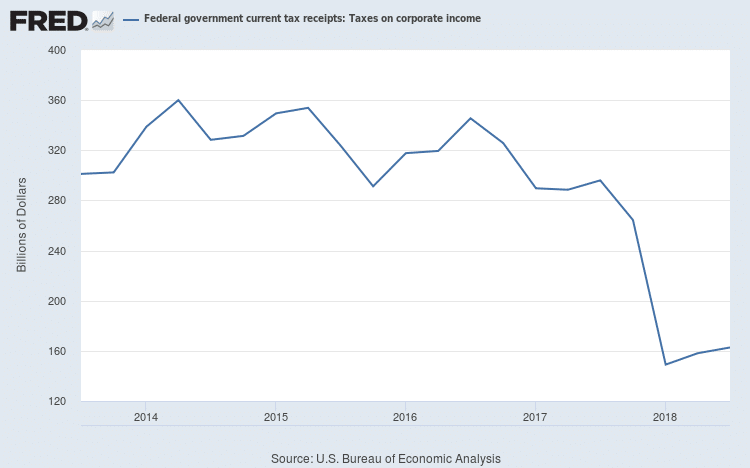
When the economy is growing anyway and the tax cut not too deep, government receipt would be lower than had there not been a tax cut, but still growing yoy because the growing economy is more than enough to compensate. For example tax receipt would have grown by 1B but because of the cut it increases by just 500M.
It’s a glass half full kind of thing. You can say it still grows by 500M. Or you can say it lost 500M potential revenue.
But if the cut is deep enough it will drag the receipt growth rate all the way to negative.
So let’s say 15% flat tax, no deduction mumbo jumbo, on income > $30k for an individual, > $60k MFJ, +$5k for each dependent. Thesholds adjusted for inflation. Capital gains treated the same as income. No distinction between short term and long term CG. Seems reasonable as long as there really are no loop holes. The Trump tax cut just moved the loop holes so there are now different hoops to jump through to maximize deductions.
The Laffer curve is still really interesting. Studies of European economies have suggested that maximum revenue occurs at ~70% total tax but conservatives have suggested that maximum revenue occurs far lower (and therefore tax cuts increase revenue). It’s very hard to interpret the data because of the impact of externalities.
1 Like
Anything over 50% is confiscation.
2 Likes
Are we talking 50% Fed or 50% total? Because when you are self-employed in CA, it REALLY adds up.
Guess he is thinking of Fed. Top rate or effective rate?
Total for CA = Fed + CA + surcharge + FICA (social security + medicare)