.
Fed keeps sayin 2% is the ideal inflation rate. Could this be too low?
.
Fed keeps sayin 2% is the ideal inflation rate. Could this be too low?
If you scroll through the 5-year and 10-year average data, you can see <2% inflation is only a recent phenomenon. The 90’s had a 10-year average in the 3-4% range.
.

Fed rates in 1990s were also 6-8%. Fed rate at 2% over inflation is normal and expected so bonds and treasury’s do not lose value over time. So if Fed claims that 4% is their neutral target rate then inflation got to be 2%. If inflation is 4% then Fed rate must be above 6% and if that happens, all assets and RE will crash by 80%.
Not sure why some folks keep on insisting that Fed is lying. Powell was as clear as he could be in the last speech. Fed’s target is 2% and until we get there they will keep raising rates. Fed will save USD and its credibility over stock and RE bubble which does not really help anyone.
.
The optimal inflation rate is a subjective concept. Some economists believe there are occasions when Central Banks may need to allow higher inflation (e.g. up to 4%).
Reasons are given in the linked article.
I was thinking of 2.75%-3%  which according to Taylor’s rule, Fed rate should be 3.6%-4%.
I also believe 2% has created too many zombie companies + encourage wanton spending by USG.
Current fed rate is 2.25-2.5%, if up another 1.25% by year end, rate would be 3.5%-3.75%  Seem like a good place to pause and really start QT if necessary.
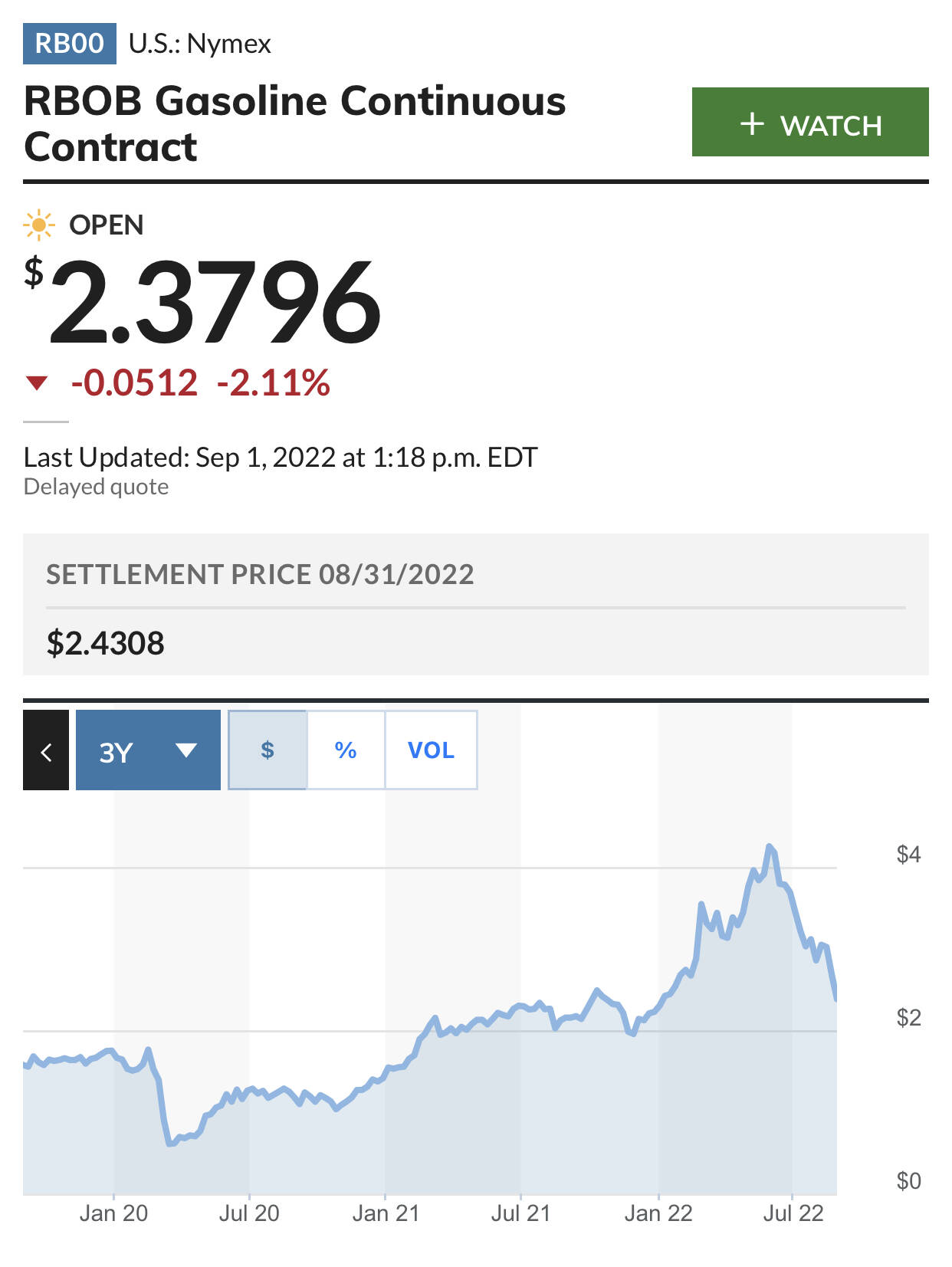
US gasoline futures is now back to 2021 level. The huge spike in 2022 is now mostly undone.
The big gap between retail and futures price means retail price will see drop continues in the next month or two. National retail average is around $3.6.
There you are taking proper place to look Neutral rate! FED already told in conference that we are currently (2.25%-2.5%) in long term neutral rate for 2.0% expected inflation.
FED exactly follows Modified Taylor Rule to control inflation.
He just want to increase one time unusual rate hike to control inflation, which may be 0.75% or 1.00%.
What time period is your historical precedence for this 80% crash? Rates in the 90’s were between 3.5-6.75%.
.
World is in crisis because too many Black Swans flying around. JPowell is the biggest  of all.
Why argue about the 75 bps hike in September? It’s already priced in. What matters is how much afterwards.
We are now at 2.5%. After the next 0.75 we will be at 3.25%. I think we won’t go beyond 4%. We will be close to done at 3.25%.
My 2 cents.
What matters is how much afterwards. => IMO, FED can not increase after Sep 2022 as the last straw is going crush the economy heavily with mass lay offs.
Since the rates are out, we can not assume it is “Priced IN”. What is happening is just sell off equities and moving to cash by big funds/banks.
They would not have priced in bankruptcies or mass lay off as they may not know who is weak and who will file bankruptcies. They will come to know during quarterly results. Now, you see why slight income reduction or slight revenue reduction brings big drop in stock value?
Last 8 months, FED increased rates slowly and this will affect all small, medium and even debt loaded large companies. After Sep 22 increase and before Jan 2023, we may see multiple bankruptcies and lay offs and the Domino Effect will go across the world.
When this happens, we will understand the “Current Priced in level” is not correct.
Multiple bankruptcies and layoffs from rates at 3-4%?
Good Lord, the world is in fragile shape.
What bankruptcies are you expecting? I think it’ll push retailers who have been circling the drain over the edge. Their market caps are already tiny though. 2008 had:
AIG $200B+
Lehman $60B+
Bear sterns $20B+
Countrywide $20B +
WaMu
Wachovia
Freddie
Fannie
The list goes on and on. Do you think we’ll get anywhere near that level of bankruptcies?
Fed funds rate had to hit 5% plus in 2007 to trigger all that.
.
Might happen. Frankly too many Black Swans, wondering why people are so sure. Interplay is too difficult to analyze. I have no idea what might happen.
This is not 2008 real estate, but inflation caused by War (oil issue) and Supply Chain (covid-issue). Workforce re-organization is happening with permanent WFH policies. Some sectors like entertainment, restaurants, Airlines, I can guess. Those who has high debt, they suffer a lot. Domino effects, even big funds/banks won’t know at this time which will get affected until they see quarterly reports…etc.
Because businesses are used to 0.25% and exceptional QE for more than decade, since Obama period. All their profit margins are aligned with 0.25% so far and many runs with slim profit margin
Just for example: Costco profit margin is 2.6% for a longer years. They have good volume turn-around and low debt, escape from issues. If it is debt ridden company, they will go negative returns. Small will file bankruptcy.
In addition, QT is going on, rewinding the funding, reducing cash circulation.
Such implication may be known by some big banks like JPM, GS or MS.
The only way for us to know is stocks will turn back at some time (stocks may over correct and then turn back).
Correct. For me too, I do not know how the future will be (next 3-9 months). Long term, we will recover.
Exactly. For example, OKTA crashes 33% today.
Bankruptcies are economic events. It has to do with the real economy. Stock price movements are financial events. It’s mostly driven by psychology in the short run.
I think it’s a mistake to conflate the two.
For bankruptcies to surge, we will need a very powerful recession. We will need to see companies and households drastically tightening their spending, and millions of people going out of work. We are just not seeing any of these right now.
They forecasted revenue growth of 32-33% vs. 43.2% in the most recent quarter. Anyone who forecasts slowing revenue growth is getting hammered. Growth SaaS companies are mostly trading below 2019 prices despite current revenue being 3-12x 2019 revenue. That’s what happens when the bearish indicator hits zero. All rational behavior is out the window. These companies aren’t at risk of bankruptcy.